Daijiworld Media Network - Dubai
Dubai, Mar 3: The United Arab Emirates has resumed a limited number of flights amid widespread travel disruption triggered by the ongoing conflict involving the United States, Israel and Iran.
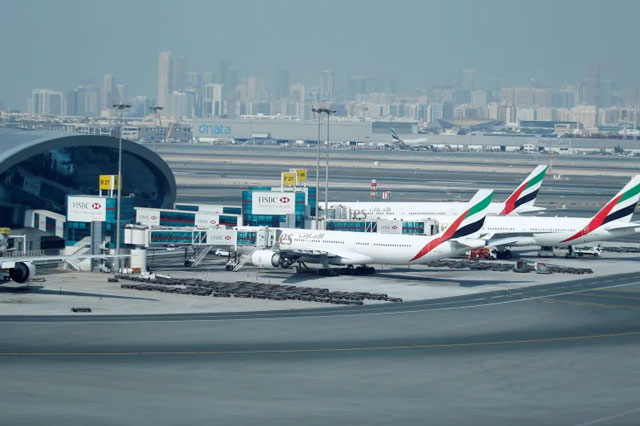
Dubai Airports confirmed on Monday that a “small number” of flights had been authorised to operate from Dubai International Airport — the world’s busiest hub for international passengers — as well as from Dubai World Central.
Authorities advised passengers not to proceed with travel plans unless directly contacted by their airline with confirmed departure timings.
Dubai-based Emirates announced the resumption of a limited number of flights on Monday evening, stating that passengers with prior bookings would be given priority.
Meanwhile, Abu Dhabi-based Etihad Airways said its commercial services would remain suspended until Wednesday, although certain repositioning, cargo and repatriation flights may operate subject to safety clearances.
Flight tracking data from Flightradar24 showed at least 16 Etihad flights departing from Abu Dhabi on Monday to destinations including London, Amsterdam, Moscow and Riyadh. Two Emirates flights from Dubai also landed in Mumbai and Chennai early Tuesday.
However, disruptions persisted. Two Etihad flights bound for Abu Dhabi were diverted to Muscat, Oman, while an Emirates service en route to Dubai reportedly returned to Mumbai.
Countries including Iraq, Jordan, Qatar and Bahrain have shut their airspace amid escalating hostilities, effectively paralysing travel across key Middle Eastern corridors. According to aviation analytics firm Cirium, more than 11,000 flights in and out of the region have been cancelled since the conflict began on Saturday.
The widespread cancellations have prompted governments to prepare evacuation plans. Germany’s Foreign Minister Johann Wadephul said Berlin would deploy chartered aircraft to Saudi Arabia and Oman to evacuate particularly vulnerable citizens stranded in the region.
Tony Stanton, consultant director at Strategic Air in Australia, told Al Jazeera that while Iran-related conflicts are often geographically concentrated, they can severely disrupt critical east-west aviation corridors, causing ripple effects globally.
He cautioned that if the conflict extends beyond a few weeks, airlines could face structural changes in route planning, higher insurance costs, and regulatory challenges.
“At that point, route maps could reset — some services suspended indefinitely, hubs losing connection banks, and traffic shifting to alternative routings or hubs perceived as lower-risk and more reliable,” Stanton said.
With tensions showing no immediate signs of easing, the aviation sector remains on high alert as carriers attempt to balance safety concerns with mounting passenger demand.