Daijiworld Media Network - New Delhi
New Delhi, Jul 18: Christopher Nolan's The Odyssey has sparked discussion among Indian audiences, with many viewers drawing comparisons between Homer's Greek epic and the Indian epics Ramayana and Mahabharata.
The comparisons are based on shared themes rather than any historical connection. There is no evidence that The Odyssey influenced the Indian epics or that Homer's work drew inspiration from them. Instead, the similarities reflect universal storytelling motifs centred on courage, sacrifice, duty and the longing to return home.
One of the most striking parallels highlighted by viewers is the hero's homecoming.
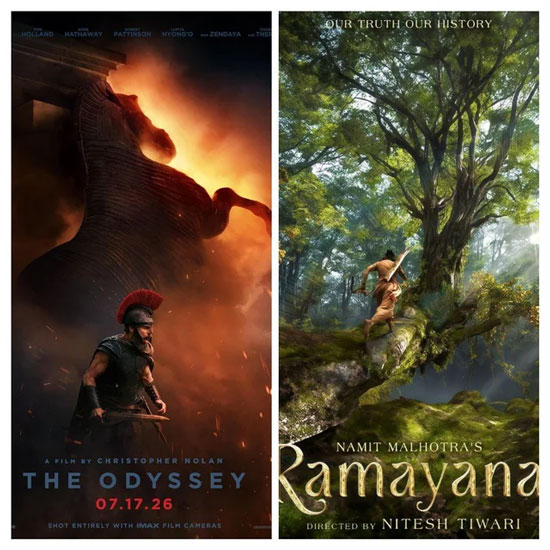
In The Odyssey, Odysseus spends 10 years fighting in the Trojan War and another 10 years attempting to return to his kingdom of Ithaca. His journey is filled with storms, mythical creatures, temptations and numerous hardships.
Many have likened this to Lord Ram's return to Ayodhya after completing 14 years of exile in the Ramayana. Although the circumstances differ, both narratives culminate in the hero returning home to reunite with loved ones, reclaim his rightful place and restore order.
Another similarity noted by audiences is the role of divine guidance.
In Nolan's adaptation, Athena, portrayed by Zendaya, repeatedly advises and supports Odysseus, offering wisdom and encouragement without directly determining the outcome of his struggles. Odysseus must still face challenges and accept the consequences of his decisions.
Viewers have compared Athena's role with that of Lord Krishna in the Mahabharata. Krishna guides the Pandavas, offering counsel and moral direction without personally fighting their battles, emphasising guidance rather than direct intervention.
The use of the bow as a symbol of worthiness has also attracted attention.
In the Ramayana, Sita's swayamvar requires suitors to lift and string Lord Shiva's mighty bow, a feat only Lord Ram accomplishes, establishing his strength and rightful claim.
Similarly, in the climax of The Odyssey, Penelope announces that she will marry the man capable of stringing Odysseus' bow and completing an archery challenge. While all the suitors fail, Odysseus, disguised as a beggar, succeeds with ease, revealing his true identity.
Though rooted in different cultures and carrying different meanings, both stories use the bow as a powerful symbol of destiny, strength and legitimacy.
Despite these thematic similarities, the three epics remain fundamentally different in their scope and purpose.
The Odyssey focuses on the personal journey of a hero striving to return home, while the Ramayana explores ideal leadership, righteousness and devotion to duty. The Mahabharata, meanwhile, presents a broader examination of dharma, morality and the complexities of human nature.
The comparisons, therefore, arise from common narrative themes rather than any direct literary connection, illustrating how stories from different civilisations often resonate through shared human experiences of perseverance, sacrifice and the search for home.