Daijiworld Media Network - New Delhi
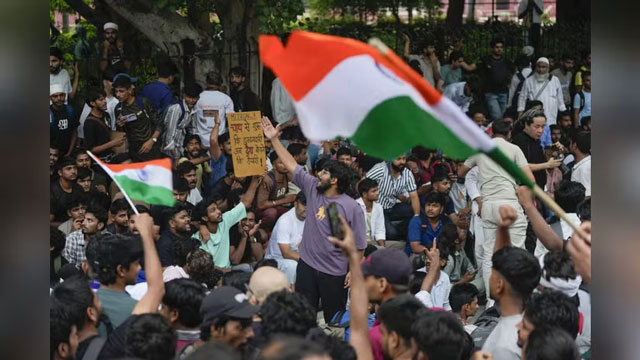
New Delhi, Jul 20: Activists affiliated with the Cockroach Janta Party (CJP) prepared to march towards Parliament on Monday despite tight security arrangements by the Delhi Police, which said no permission had been granted for the proposed demonstration.
The march was originally announced by activist Sonam Wangchuk, who was shifted to Safdarjung Hospital after a 20-day hunger strike and has continued his fast from the hospital.
CJP spokesperson Saurav Das said the organisation remained willing to hold talks with the government over its long-pending demands for reforms in the education system, including measures to prevent examination paper leaks.
Das said the administration had initiated dialogue only recently but had not provided any clarity on the government's position.
"The administration is trying to open talks with the government. They have come very late, but we have opened our hearts and said that we are willing to talk to them. There has been no clarity from their side as of now. The ball is in their court," he said.
Das said Wangchuk's health remained stable and that he continued his hunger strike.
"Sonam ji, so far he is stable, and he is continuing his hunger strike. He has sent his very best wishes to the young protesters of this country who have finally awakened to this very difficult, very dead system that does not listen to them at all. A peaceful march will happen very soon. Peaceful protesters have been gathered here for the past 30 days, and we have shown how to carry out a peaceful protest and put our points forward," he added.
Earlier, Wangchuk announced that he would end his hunger strike if the government accepted responsibility for recent failures in the education system, including alleged examination paper leaks, or if Members of Parliament assured him that the issue would be raised during the Monsoon Session of Parliament.
In a post on X, Wangchuk outlined three conditions under which he would call off the fast. He said he would end the strike if the government accepted accountability for the recent failures in the education system, if he and the CJP leadership were allowed to reach Parliament and receive assurances from MPs that the matter would be raised in the House, or, if his health prevented him from travelling, MPs from different political parties visited him at Safdarjung Hospital and gave the same assurance.
He also described his stay at the hospital as an "illegal detention", alleging that his freedom of movement, speech and communication had been restricted.
Meanwhile, supporters gathered at Jantar Mantar to begin the proposed march towards Parliament.
Addressing the protesters, CJP president Abhijeet Dipke asserted that the march could not be stopped.
"The biggest march in India's history is about to take place. For the past 10-12 years, attempts have been made to destroy democracy in this country. By sitting at Jantar Mantar for a month, you have revived democracy," Dipke said.
He added that supporters from across the country were arriving in large numbers after the month-long sit-in protest, demonstrating the movement's growing support.
Delhi Police, however, issued a public advisory stating that no permission had been sought or granted for any march to Parliament by the CJP.
The police said prohibitory orders under Section 163 of the Bharatiya Nagarik Suraksha Sanhita (BNSS), corresponding to the erstwhile Section 144 of the Code of Criminal Procedure, remained in force across the New Delhi district.
Under the restrictions, protest marches, processions, demonstrations and assemblies of five or more persons are prohibited, except at the designated protest site at Jantar Mantar with prior permission.
Police said elaborate security arrangements had been made in view of the commencement of the Monsoon Session of Parliament to ensure public safety, protect vital government installations and provide security to protectees.
The advisory warned that anyone violating the prohibitory orders would face prosecution under Section 223 of the Bharatiya Nyaya Sanhita (BNS) and other applicable provisions of law.