Daijiworld Media Network – Mangaluru
Mangaluru, Aug 5: In a major relief to patients and their families, the Government Wenlock Hospital in Mangaluru has decided to scrap the rule mandating replacement blood donors for patients requiring plasma therapy.
Health and family welfare minister U T Khader lauded this move, stating that the decision taken by the Dakshina Kannada district's Wenlock Hospital blood bank is a positive development. He added that the government is now considering implementing this beneficial rule across the entire state.
Currently, when a patient is admitted for treatment and requires plasma, hospitals often pressure relatives to arrange for blood donors. However, officials point out that this is unnecessary and causes undue stress, as thousands of units of Fresh Frozen Plasma (FFP) are already stocked in blood banks across the state.
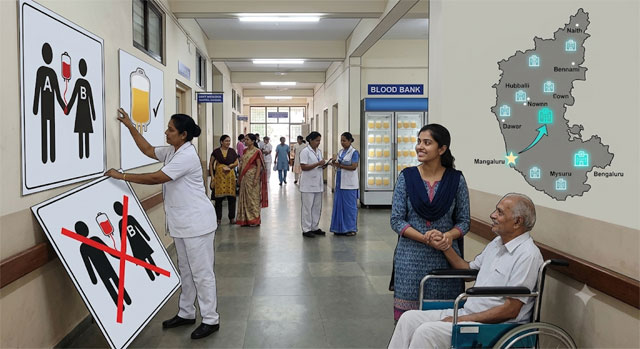
AI image
According to the state health department's Jeeva Sanjeevini portal, as of Monday, there are a staggering 60,000 units of FFP available in reserve.
The Dakshina Kannada blood transfusion officer stated that there is no moral justification for demanding replacement blood from patients for plasma, given these high reserves. Due to storage space constraints in blood banks, surplus plasma is often sold to pharmaceutical companies in large quantities.
With the implementation of the new rule at Wenlock, the overall demand for replacement blood is expected to drop by 50%. The officer also warned that strict action will be taken if complaints are received about hospitals forcing families to bring replacement donors for plasma.
Guidelines stipulate that blood banks should collect 95% of their required blood through voluntary donation camps. They should only request replacement donors for extremely rare blood types, which constitute about 5% of the requirement.
Surplus plasma sold for medicine manufacturing
Extracted plasma can be stored in deep freezers at minus 80 degrees Celsius for up to two years. If it remains unused after a year, it is sold to fractionation companies for the production of life-saving medicines.
The Government Wenlock Hospital alone recently sold excess plasma worth Rs 30 lac. The selling price of plasma, which was Rs 1,600 per litre five years ago, has now surged to Rs 5,600 per litre.
Plasma therapy or plasma exchange is typically required for severe medical conditions such as Guillain-Barre syndrome, various nerve-related disorders, Myasthenia Gravis, liver failure, MDP, and yellow phosphorus poisoning.
During standard blood collection, a single unit of donated blood is separated into red blood cells, plasma, platelets, and cryoprecipitate, meaning one person's donation can potentially save up to four lives.