Daijiworld Media Network – Bengaluru
Bengaluru, Aug 6: More than 1.11 crore voters in Karnataka have been identified under the Absent, Shifted, Dead, Duplicate/Already Registered and Others (ASDDO) categories during the ongoing Special Intensive Revision (SIR) 2026 of electoral rolls, with over 50 lac cases reported from four Bengaluru zones alone.
The Election Commission has clarified that voters included in the ASDDO list have not been removed from the electoral rolls and will undergo verification before any further action is taken. The lists have been shared with recognised political parties and are also available with Booth Level Officers (BLOs) for scrutiny.
The ASDDO list refers to voters whose records have been flagged for verification as they may have shifted residence, been found absent during verification, have duplicate entries, are reported deceased, or fall under other categories requiring examination.
Out of Karnataka’s 5.54 crore registered voters, a total of 1,11,07,461 electors have been placed under the ASDDO category as of August 4, accounting for 20.03% of the electorate. The names of voters included in this category will not appear in the draft electoral rolls scheduled to be published on August 17.
Chief Electoral Officer (CEO) V Anbukumar has released the link to the portal where voters can check their ASDDO status. The district-wise lists can be accessed at https://ceo.karnataka.gov.in/asddo.html. However, links for districts including Belagavi, Raichur, Shivamogga and Bengaluru Urban are yet to be made available.
Giving an update on the SIR process, Anbukumar said the distribution of enumeration forms has been completed 100%, while digitisation of forms has reached 79.93%. As of 2 pm on August 5, only 22,977 forms remained pending for digitisation.
“As of June 16, 2026, there are 5,54,32,314 electors in the electoral roll. The enumeration forms were printed and delivered to the Booth Level Officers (BLOs),” Anbukumar said in a press release.
The release stated that 4.43 crore enumeration forms have been digitised, while all 5.54 crore forms relating to voters identified under the ASDDO category have been processed. The remaining pending forms account for just 0.04% of the total.
The ASDDO category includes 66,64,943 voters who have permanently shifted, 16,30,012 absent or untraceable voters, 16,30,872 deceased voters, 6,89,904 voters already registered elsewhere, and 4,88,974 cases classified under other reasons.
Voters who believe they have been wrongly classified as absent, shifted or under any other incorrect category can approach their respective BLO or Electoral Registration Officer (ERO) and provide proof that they continue to reside at the registered address. Following verification, their enumeration forms can be restored. The facility will remain available until August 8.
District-wise data shows that Bengaluru accounts for the highest number of ASDDO-listed voters. The figures include 18,13,010 voters in Bengaluru Urban (45.09%), 11,07,678 in BBMP South (51.65%), 11,07,027 in BBMP North (47.46%) and 9,15,035 in BBMP Central (48.42%).
Other districts with a high number of voters under the ASDDO category include Mysuru (5,72,509), Kalaburagi (5,35,403), Belagavi (5,07,983), Raichur (3,21,107), Vijayapura (3,01,264) and Dharwad (2,81,242).
Udupi recorded the highest digitisation rate of enumeration forms at 93.95%, followed by Haveri (91.38%), Uttara Kannada (91.27%) and Dakshina Kannada (91.16%), the CEO said.
Among Bengaluru areas, digitisation progress remained comparatively lower, with BBMP South recording 48.35%, followed by BBMP Central (51.58%), BBMP North (52.54%) and Bengaluru Urban (54%).
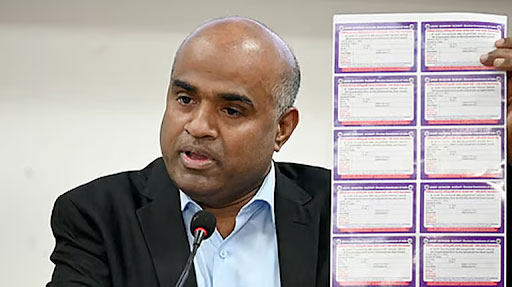
For Bengaluru and the Greater Bengaluru region, the CEO said 10 lac Form-6 applications have been printed and supplied to Electoral Registration Officers to facilitate registration of eligible citizens who will attain 18 years of age on or before October 1, 2026.
Between June 16 and August 4, election officials received 12,20,312 applications, including 3,72,201 Form-6 applications, 3,207 Form-6A applications, 30,952 Form-7 applications and 8,13,952 Form-8 applications, according to the release.