Daijiworld Media Network - Washington
Washington, Aug 10: The United States is running considerably low on critical missile interceptors and other munitions following months of war with Iran, former US Defence Secretary Mark Esper has said, raising concerns over Washington's ability to replenish its weapons stocks and maintain military readiness against other potential threats.
Esper, who served as Defence Secretary during President Donald Trump's first term, said shortages of Patriot and Terminal High Altitude Area Defence (THAAD) interceptors were serious and warned that rebuilding the depleted stocks would take time.
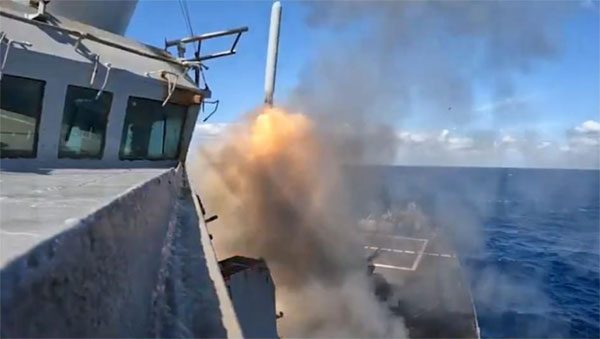
"It is a serious situation that goes back to the end of the Cold War and decisions we made between them and then with the onset of the Iraq and Afghanistan wars," Esper told ABC News on Sunday.
"And frankly, it accelerated during the Biden administration when we were expending munitions or giving munitions to Ukraine. And it's, of course, in the last six, seven months, it's really taken a toll that we've now find ourselves considerably low with regard to interceptors such as Patriot and THAAD, and to some ground attack weapons as well," he said.
Esper said his biggest concern was China and the message that depleted US weapons stockpiles could send about American deterrence.
"When I look at the world, I'm most concerned about China and the messages it may be sending there and the deterrent effect of our munition stockpiles, and more importantly of our defence industrial base," he added.
According to NBC News, the Pentagon is seeking an additional $67 billion in defence funding, partly to replenish depleted weapons stocks.
Democratic Senator Chris Murphy of Connecticut said he would oppose additional funding while the war with Iran continued, but would support replenishing US arsenals once the conflict ended.
"We have used up almost all of our interceptors, the majority of our Tomahawks. We have put the United States in a dangerous position," Murphy said.
"We have allowed Russia and China to imagine things that they couldn't have imagined early because of our inability to defend ourselves and our allies," he added.
Republican Senator Jim Banks of Indiana, meanwhile, defended Trump's handling of the war with Iran and said the President's legacy would be closely linked to preventing Tehran from obtaining a nuclear weapon.
"His legacy is going to be largely wrapped up in ensuring that Iran never has a nuclear weapon," Banks told NBC News.
He claimed that US military operations had destroyed 85 per cent of Iran's ballistic missiles and damaged its defence industrial base. Banks also credited Trump's naval blockade with crippling Iran's economy.
Esper said the administration was pressing defence companies to accelerate weapons production, but cautioned that rebuilding the stockpiles would not provide an immediate solution.
"When you're talking about taking two years to build a Patriot missile, whatever we do now is not going to help in the short term, but nonetheless needs to be done for strategic reasons," he said.
Patriot and THAAD are among the United States' principal missile-defence systems. Patriot batteries can intercept aircraft, cruise missiles and some ballistic missiles, while THAAD is designed to intercept ballistic missiles during the final phase of their flight.