Daijiworld Media Network - New Delhi
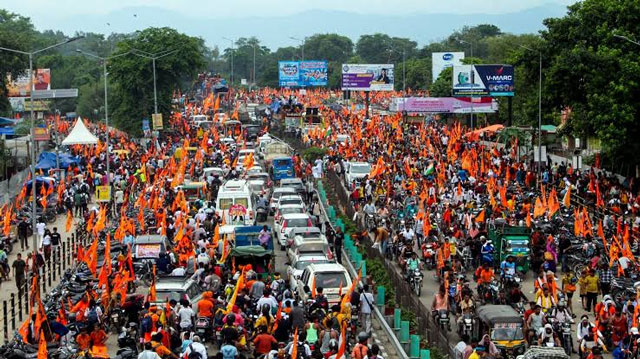
New Delhi, Aug 11: While hundreds of devotees participating in the annual Kanwar Yatra have caused traffic disruptions across Delhi, residents living near temporary Kanwar camps say they are facing days of blaring music, sleepless nights, rattling windows, clogged roads and mounting garbage.
Residents of B-Block in Ramesh Nagar, a west Delhi neighbourhood between Kirti Nagar and Rajouri Garden, said the steady movement of Kanwariyas and two camps set up below the Ramesh Nagar metro station had severely disrupted daily life.
Sound-level measurements recorded by Hindustan Times showed noise levels inside homes closest to the camps crossing 90 decibels. At one residence, readings reached 90.6 decibels at 6.30 pm, 91.4 decibels at 7.30 pm and 95 decibels at 8.30 pm.
At a house around 200 metres from the camps, readings ranged from 67.2 to 76.3 decibels during the afternoon and remained between 65 and 75 decibels from 6 pm to 11 pm.
Noise levels recorded at the camp itself were considerably higher, with readings of 82.4, 101.3, 90.3 and 92.1 decibels between 3.20 pm and 6.20 pm, followed by 95, 99.2 and 94 decibels between 7.20 pm and 9.20 pm.
The World Health Organization recommends limiting exposure to such high noise levels, warning that prolonged exposure can cause permanent hearing damage. Central Pollution Control Board norms prescribe ambient noise limits of 55 decibels during the daytime and 45 decibels at night in residential areas.
Residents said the loud music and announcements from boomboxes continued late into the night, with bass from the speakers strong enough to make walls and windows vibrate.
Gurbir Singh, 55, a stockbroker living directly opposite one of the camps, said he had barely slept for three days and that his elderly mother was experiencing palpitations.
He said the annual disruption had made it difficult for him to sleep and work peacefully, adding that the loud music continued for prolonged periods.
Shekhar Bhatia, 39, an employee of a multinational company whose parents are over 70, said office calls had been affected and his father could not sleep peacefully because of the noise.
Ana Gogia, 38, a chartered accountant working for an MNC in Gurugram, said the disruption extended beyond homes immediately surrounding the camps. Heavy traffic made it difficult to reach children's bus stops, offices, gyms and doctors, while people working from home struggled to participate in calls.
Gogia, who suffers from migraine and laryngitis, said the continuous noise was particularly difficult to cope with. School routines have also been affected, with residents reporting severe congestion around school hours and some parents choosing to collect their children themselves rather than rely on school buses.
Komal Mutreja, 45, a homemaker and mother of two children aged five and seven, said noise, traffic and sanitation were among the biggest concerns.
She said loudspeakers, music and announcements were disturbing her children and making it difficult for them to study.
Residents also complained about blocked and diverted roads and the accumulation of garbage around the camps. Empty water bottles, chips packets and other waste were allegedly being discarded along roads and near the temporary structures.
Some residents also raised safety concerns, alleging that some devotees carried baseball bats and wooden sticks while walking in the middle of roads and crossing residential streets.
Residents said they had repeatedly approached the local police station over noise and traffic-related issues but alleged that the action taken had been temporary.
One resident, who works in the corporate sector and did not wish to be identified, said police had previously responded to complaints by asking those at the camps to lower the volume, but the loud music resumed later.
Residents stressed that their concerns were not about the Kanwar Yatra or the religious practice itself, but about the scale of the celebrations and their impact on people living along the routes.
They said they wanted authorities to ensure that religious activities did not come at the cost of residents' sleep, work, children's education, traffic movement and basic sanitation.