Daijiworld Media Network - Kathmandu
Kathmandu, Sep 6: Rescue teams in Nepal continued their search for thousands of people still missing after devastating flash floods and landslides, as authorities struggled to identify hundreds of bodies recovered from the disaster.
According to the latest figures released by Nepalese authorities, 1,344 bodies have been recovered and around 5,000 people remain missing. More than 13,100 people have been rescued so far, including several people who were found alive days after the disaster.
The disaster was triggered by an ice-rock avalanche near the Nepal-Tibet border on Aug 26, sending a massive surge of water and debris through the Bhotekoshi River. The floods devastated settlements in northern and central Nepal, sweeping away homes, vehicles, roads, bridges and hydropower infrastructure.
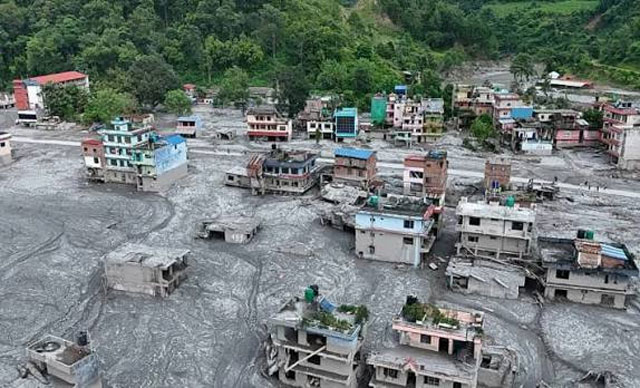
The disaster also caused heavy casualties on the Chinese side of the border. Chinese state media reported dozens of deaths in Tibet, while hundreds of people remained unaccounted for.
Identifying the dead has emerged as one of the biggest challenges facing authorities. Officials said at least 85 children were among the recovered bodies, while around 500 bodies were recovered with body parts missing. Prolonged exposure to water, mud and debris has made visual identification difficult.
Nepal's National Disaster Risk Reduction and Management Authority said Chitwan district accounted for the largest number of recovered bodies, with 362, followed by Nawalparasi East, Nawalparasi West, Nuwakot, Rasuwa, Gorkha, Dhading and Tanahun.
Only a small proportion of the recovered bodies have so far been formally identified and handed over to relatives, leaving thousands of families waiting for information about missing loved ones.
Nepal Police has begun collecting DNA samples from relatives of missing people to help establish the identities of unidentified bodies and human remains. Relatives can provide samples through the Nepal Police Hospital in Kathmandu or their nearest district police office. Authorities have also preserved identification details and photographs of unidentified bodies to assist families in confirming their relatives.
The rescue operation has continued at several hydropower projects where workers are believed to have been trapped inside tunnels filled with mud and debris. Teams from Nepal, India and China have been assisting with specialised rescue operations at projects including Upper Trishuli-1, Upper Trishuli-3A, Upper Trishuli-3B, Haku, Chilime and Langtang.
The rescue effort received a major boost after a Chinese national was pulled alive from a hydropower tunnel 10 days after the disaster. Lu Haitao was rescued from a 225-metre tunnel at the Upper Trishuli-1 Hydropower Project and taken to hospital for treatment. Two Nepali workers were also rescued from another tunnel, while a 60-year-old Nepali woman was found alive after spending 10 days trapped beneath mud and debris in Nuwakot.
The survival of people trapped for more than a week has kept hopes alive that more victims could still be found, although rescue officials face increasingly difficult conditions as tunnels remain blocked and unstable terrain continues to threaten operations.
Meanwhile, a fresh flood struck Gorkha district early Sunday after the Namrung Khola overflowed, sweeping away four houses and a suspension bridge. Residents managed to escape after receiving warning of the approaching flood and no casualties were reported.
Authorities said the river may have been temporarily blocked near its source before suddenly releasing a surge of water, mud and debris downstream. The Namrung Khola flows into the Budhigandaki River, prompting officials to warn communities along the river to remain alert.
The latest flooding also damaged two small hydropower projects in the Namrung area and disrupted movement after the suspension bridge was washed away.
Nepal's government has continued to deploy security personnel, rescue equipment and technical teams to affected areas, while international assistance is being provided for specialised search operations. The government is also monitoring river levels and unstable areas for signs of further flooding or landslides.
The scale of the disaster has made the operation one of Nepal's most challenging search-and-rescue efforts in recent years, with authorities simultaneously recovering bodies, searching for missing people, identifying the dead and attempting to reach workers trapped inside damaged hydropower tunnels.