Daijiworld Media Network - Udupi
Udupi, Sep 8: A rare 14th-century relic, identified as a 'Siditale' hero stone, has been discovered in the outer prakara of the historic Panchalingeshwara temple in Barkur, the ancient capital of the Alupas and the Vijayanagara Empire.
The significant archaeological find was made during an epigraphical survey conducted amidst the ongoing renovation of the temple. The survey was a joint initiative by the Veera Rani Chikkayi Tayi Trust (R), Gulladi, and the Adima Kala Trust (R), Udupi, stated Prof T Murugeshi, a prominent archaeologist of the region, in a press release.
While self-sacrificing hero stones dating from the 9th to the 15th centuries are commonly found across South India, this is the first time a 'Siditale' type of hero stone has been discovered in Tulunadu. Prof Murugeshi noted that he had previously reported three such hero stones from the 10th-century Ganga period in Coorg.
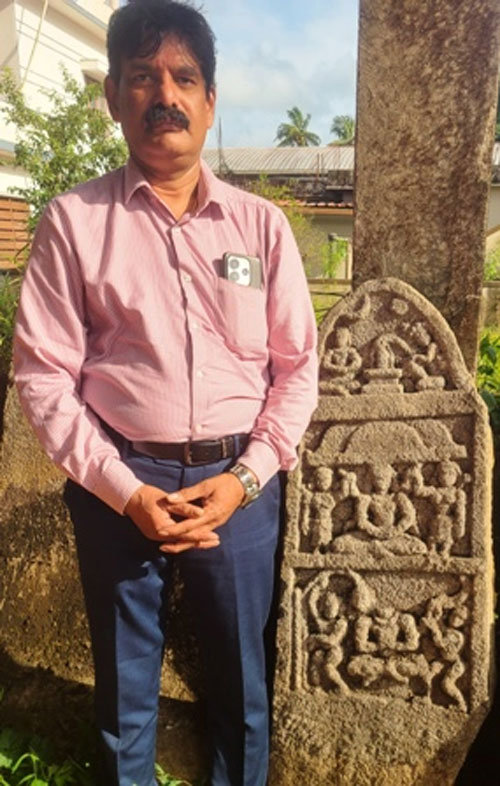
Elaborating on the structure of the four-foot-tall hero stone, Prof Murugeshi explained that it is intricately carved into three distinct panels. The lower panel depicts a self-sacrificing person sitting on a mud mound in a meditative posture (dhyana bangi). A butcher stands to his left with a sword, while a man on the right tightly holds a bamboo pole. The head of the person being sacrificed is tied to the tip of the bamboo. Immediately after the decapitation, the severed head would spring up and swing in the sky due to the bamboo's tension, a practice known as 'Siditale'.
The second panel illustrates apsaras carrying the deceased hero to heaven. In the top panel, the hero is shown seated before Lord Shiva on the left, alongside an archaka on the right. Stylistically, the stone dates back to the 14th century, throwing new light on the rich antiquity of Tulunadu.
Prof Murugeshi expressed his gratitude to Dr Raghuram Shetty Gulladi for financially supporting the discovery. He also acknowledged the assistance of temple administrator Nagashayana, former moktesvar Manjunath Rao, and MSRS College Shirva archaeology students Sinchith and Shodan during the survey.