Daijiworld Media Network - Nablus
Nablus, Sep 10: Palestinian businesses in the occupied West Bank are facing mounting losses due to restrictions on movement, with military checkpoints causing severe disruptions to the transport of goods and workers.
In Rujeib village, southeast of Nablus, Al-Kamel Dairy Factory has suffered a sharp decline in business since the escalation of the Israeli war on Gaza in October 2023. Established in 2022, the dairy factory now has two distribution trucks permanently parked in its yard due to declining demand and difficulties in movement.
According to the Colonization and Wall Resistance Commission (CRRC), there are around 925 checkpoints and military gates across the occupied West Bank, including 147 in the Nablus governorate, which is Al-Kamel's main market. Transport movement across the West Bank has fallen by more than 50 percent since the onset of the war on Gaza.
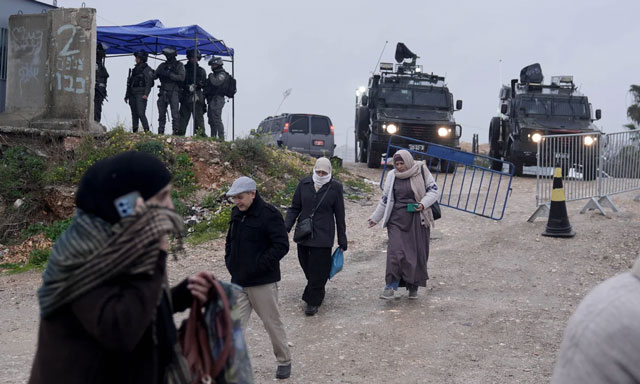
The restrictions have increased production and transportation costs for Palestinian businesses. Al-Kamel's sales have declined by 30 to 40 percent, forcing the company to lay off at least 12 workers.
"Since the beginning of the company's establishment, there were several challenges, and among the most prominent of these challenges were the checkpoints and gates spread across the West Bank, and especially the city of Nablus," Dweikat told Al Jazeera.
"There is a severe siege on the city of Nablus, as you can barely find an entrance to the city of Nablus without a permanent or semi-permanent checkpoint. These checkpoints have led to obstructing movement and increasing transport costs, which necessarily reflects on the product's price and production costs."
The economic slowdown has also been compounded by high unemployment, the suspension of work permits for Palestinian workers in Israel during the war and falling salaries.
"Unfortunately, in light of the bad economic situation we suffer from due to recession and economic contraction, factories sometimes cannot reflect this increase in cost onto the citizen, because the economic situation is originally deteriorating," Dweikat said.
Al-Kamel's milk trucks now wait for two to three hours to leave Nablus and face even longer delays at checkpoints around the city. At the Awarta checkpoint, located about 2 km from the factory, trucks can reportedly wait for up to four hours.
The delays have resulted in 10 tonnes of Al-Kamel's milk being wasted, highlighting the impact of movement restrictions on perishable goods.
"We work in the dairy products sector, which is a very sensitive sector that requires refrigerated trucks, and therefore the volume of challenges is very large for us," Dweikat said. "Frankly, we were forced to sacrifice many of our customers located outside the city of Nablus as a result of these obstacles."
At times, drivers are forced to abandon plans to leave the city when delays extend into midday.
"In the end, when it is midday, we tell the driver: 'That's it, there is no longer room to exit ... and this represents a real danger to the safety of our employees in light of the deteriorating security situation,'" Dweikat said.
A study published by the Palestine Economic Policy Research Institute (MAS) in March 2025 found that delays at 14 monitored military checkpoints ranged from 15 to 50 minutes. The average delay for journeys outside the Nablus governorate reached 42 minutes, representing a 77.9 percent increase in travel time.
The study estimated that 191,146 working hours are lost every day due to checkpoint delays, costing the Palestinian economy around 2.8 million shekels ($764,600) per day, or 62.2 million shekels ($16.8 million) a month.
Drivers also have to take longer routes to bypass closed checkpoints, resulting in an estimated additional fuel cost of 71,000 shekels ($19,203) every day.
The restrictions have also affected businesses in Nablus. Local spice merchant Mansour Aliwi described the city as a "ghost town", saying the closure of crossings and checkpoints has reduced the number of shoppers reaching the city from surrounding villages and rural areas.
"Frankly, the crisis is deepening month after month due to Israel's closure of crossings and checkpoints, and the prevention of the entry of Arab Israelis into the West Bank," Aliwi told Al Jazeera. "We rely heavily on shoppers from the rural areas and villages, but the checkpoints have prevented people from arriving."
The Israeli separation barrier is another major obstacle to movement. The CRRC said the barrier, built from 2002, currently isolates more than 295 sq km of Palestinian land.
"If the occupation state completes building the planned parts, it will completely isolate 560 sq km [216 sq miles], approaching 9 percent of the total land in the West Bank," the CRRC said.
Palestinian business journalist Jafar Sadaqa told Al Jazeera that intensified checkpoints and movement restrictions were affecting businesses and preventing workers from reaching their workplaces.
"The intensification of these checkpoints over the past three years has led to far-reaching consequences, such as the bankruptcy of companies and their cessation of operations, and subsequently the loss of jobs for thousands of workers and employees, pushing unemployment to unprecedented rates," Sadaqa said.
He said the economic impact extended beyond direct financial losses, with restrictions affecting the Palestinian economy's ability to develop commercial and regional ties.
"It is difficult to calculate the total size of the loss in the Palestinian economy due to these measures," Sadaqa said.
"They are not limited only to direct financial losses resulting from preventing the movement of individuals and goods, and the destruction of agricultural lands and facilities, but also include the lost opportunities for the Palestinian economy to exploit natural and commercial resources, and the prevention of any possibility to develop regional and global economic relations."