Daijiworld Media Network - Washington
Washington, Oct 7: Nearly three years after the start of the Gaza war, the United States continues to provide substantial military, financial and diplomatic support to Israel, despite growing criticism over civilian casualties and the conduct of the conflict.
The administrations of former President Joe Biden and current President Donald Trump have maintained extensive security assistance to Israel since the Hamas-led October 7, 2023 attack on southern Israel. While both administrations have at times criticised aspects of Israel’s military operations, Washington’s broader military support has continued.
According to the Congressional Research Service, US military aid to Israel has remained a major component of the bilateral relationship, with congressional majorities continuing to support security assistance while an increasing number of lawmakers have questioned unconditional aid.
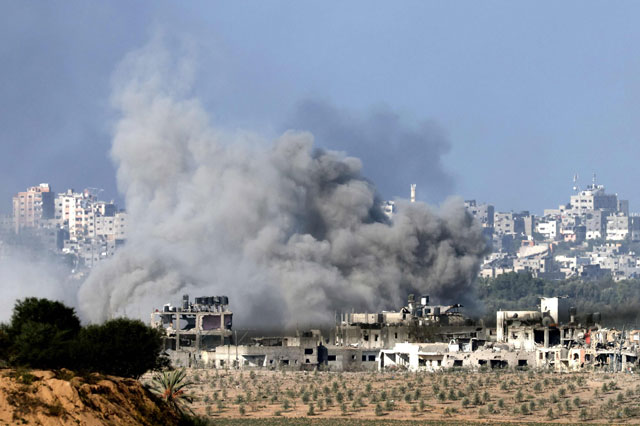
The United States has provided Israel with approximately $3.8 billion a year under a 10-year security assistance agreement signed in 2016. Additional funding approved after the October 2023 attacks included a major supplemental package for Israel. US assistance includes Foreign Military Financing, funding for missile defence and other security programmes, as well as support for weapons procurement.
The US has also approved major arms sales to Israel since the beginning of the war. These include fighter aircraft, tank ammunition, bombs, missiles and other military equipment. Some sales have been approved through emergency procedures that allow the administration to bypass portions of the normal congressional notification process.
US-made weapons have become a major focus of criticism from rights organisations, which have linked some American-supplied munitions to civilian deaths in Gaza. Israel has rejected allegations of deliberately targeting civilians and says its military operations are directed against Hamas.
William Hartung, a defence analyst who has studied US-Israel military assistance, told Al Jazeera that the scale of American weapons support means Washington bears responsibility for the consequences of the weapons it supplies.
The US-Israel military relationship extends beyond weapons transfers. Washington has for decades supported Israel’s military capabilities and has maintained a policy aimed at ensuring that Israel retains a so-called Qualitative Military Edge over neighbouring countries.
US assistance also supports Israel’s missile defence systems, including Iron Dome and David’s Sling, while Israel maintains access to a US weapons stockpile stored in the country for emergency use.
The United States has additionally provided diplomatic support to Israel. Before the October 2025 ceasefire, Washington used its veto power at the UN Security Council on multiple resolutions concerning the Gaza conflict.
The Trump administration has also taken measures against the International Criminal Court after the court issued arrest warrants for Israeli Prime Minister Benjamin Netanyahu and former Defence Minister Yoav Gallant. Washington has sanctioned ICC officials and has intensified its campaign against the court. Reuters reported in September that the Trump administration was preparing broader sanctions as part of an effort to isolate the ICC.
The US position has faced growing criticism domestically. Opposition to additional military and economic assistance to Israel has increased among sections of the Democratic electorate, while some lawmakers from both chambers of Congress have attempted to block or restrict weapons transfers.
Senator Bernie Sanders and other lawmakers have introduced measures seeking restrictions on US arms sales to Israel. In April 2024, the Senate voted on legislation concerning the sale of military bulldozers, while further efforts have been made to require investigations into the use of US weapons and the deaths of American citizens in the occupied West Bank.
At the same time, many US lawmakers continue to support strong military ties with Israel. Congressional proposals have sought to deepen technological and defence cooperation between the two countries and integrate the relationship more closely with the US defence establishment.
The debate has intensified as the Gaza conflict continues despite the ceasefire that began in October 2025. Reuters reported on October 6 that the ceasefire has reduced the scale of fighting compared with the earlier full-scale war, but Israeli strikes have continued and Israel still controls around two-thirds of Gaza. More than 1,400 Palestinians have reportedly been killed since the ceasefire, according to Gaza health authorities cited by Reuters.
The continuing military relationship between Washington and Tel Aviv has therefore become an increasingly contested issue in US politics, with supporters describing the assistance as essential to Israel’s security and critics calling for greater conditions on military aid and stronger measures to protect Palestinian civilians.