Daijiworld Media Network - Washington
Washington, Apr 11: In a landmark moment for space exploration, NASA’s Artemis II astronauts safely returned to Earth, splashing down in the Pacific Ocean off the coast of San Diego after completing a groundbreaking 10-day journey around the Moon.
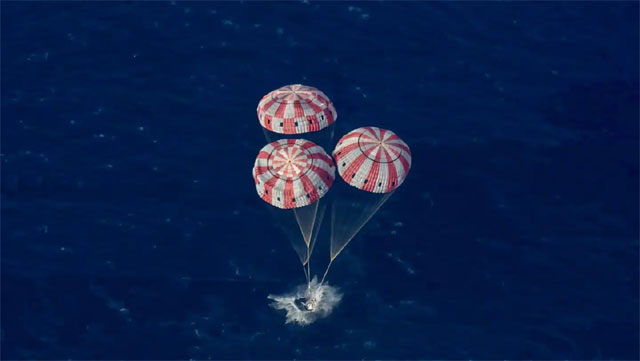
The Orion spacecraft carried astronauts Reid Wiseman, Victor Glover, Christina Koch, and Jeremy Hansen, who made a parachute-assisted landing at 8:07 p.m. Eastern time. Recovery teams quickly reached the capsule to ensure the crew’s safe retrieval.
The mission marked the first crewed test flight under NASA’s Artemis programme, sending humans beyond low Earth orbit for the first time in over 50 years. The astronauts travelled as far as 252,756 miles from Earth—surpassing the distance record set during the Apollo 13 mission—and conducted observations of the Moon’s far side, including ancient craters and basins.
Artemis II also set notable milestones: Glover became the first Black astronaut to reach the Moon’s vicinity, Koch the first woman, and Hansen the first Canadian to do so.
Despite minor technical issues, including a malfunction in the onboard toilet system and unusual cabin odours, the mission proceeded successfully without major disruptions.
The return journey was one of the most intense phases, with the spacecraft re-entering Earth’s atmosphere at speeds of nearly 25,000 miles per hour and enduring temperatures close to 5,000°F. The capsule deployed drogue and main parachutes in sequence before its smooth splashdown.
Following recovery, the astronauts were transported to the USS John P. Murtha for initial medical evaluations.
NASA Administrator Jared Isaacman praised the achievement, highlighting the years of effort behind the mission. US President Donald Trump also lauded the mission, calling it “spectacular” and the landing “perfect.”
As a crucial step in the Artemis programme, Artemis II paves the way for Artemis III, which aims to test docking systems and ultimately enable astronauts to land on the Moon later this decade, marking a new era of sustained human presence in deep space.