Pics: Spoorthi Ullal
Daijiworld Media Network – Mangaluru (NJC)
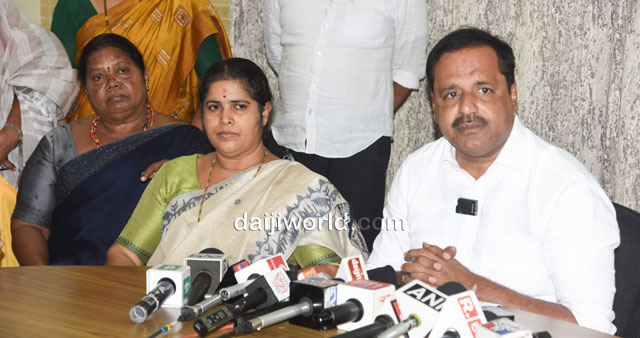
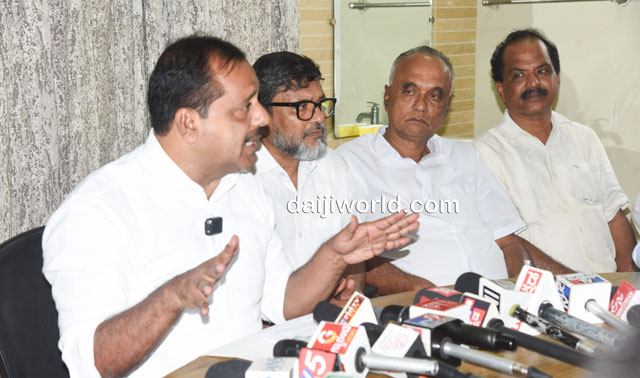
Mangaluru, Jul 30: Karnataka health and family welfare minister U T Khader on Thursday unveiled an ambitious roadmap to transform the state’s public healthcare system through complete digitisation, the expansion of Tele-ICU services, strengthened newborn care, and the integration of AYUSH facilities into mainstream hospitals.
Addressing a press conference at the Circuit House in Mangaluru, the minister also launched a scathing political attack on a BJP leader over a controversial remark against Rahul Gandhi, describing it as an affront to the culture and dignity of the coastal region.
Speaking to journalists, Khader stated that the health department has launched a large-scale digital transformation programme aimed at modernising government healthcare services across Karnataka. As part of this initiative, high-speed broadband connectivity is being rolled out to all Primary Health Centres (PHCs), Community Health Centres (CHCs), and taluk hospitals, building the backbone for a fully digital healthcare ecosystem.
He explained that a paperless hospital management system, successfully piloted across 40 hospitals in four districts using diverse technology platforms, is now being scaled up to 183 additional government facilities, including district hospitals, taluk hospitals, and CHCs.
Under the upgraded framework, every patient’s consultation history, laboratory test results, pharmacy records, blood pressure, blood sugar readings, and other clinical details will be stored digitally. This will allow medical staff to track long-term health trends during subsequent visits.
Khader added that the government eventually plans to link private hospitals to the digital platform, ensuring a patient’s complete medical history is seamlessly accessible regardless of where care is delivered.
Addressing concerns over the shortage of specialist doctors, the minister announced that Tele-ICU units will be set up at taluk hospitals and CHCs. Under this arrangement, specially trained nurses will handle hands-on patient management locally while specialist doctors monitor critical cases remotely, offering real-time guidance through digital communication systems.
To boost rural healthcare, the government is also introducing Paediatric Emergency Care and Special Newborn Care Units (SNCUs) at taluk hospitals and CHCs. This will ease the burden on rural families, reducing the need to travel long distances or rely on expensive private facilities for neonatal care.
Touching on budget allocations, Khader disclosed that around Rs 42 crore has been earmarked for digital infrastructure, with an additional Rs 30 crore sanctioned to set up Tele-ICU facilities across the 183 institutions.
Elaborating on the implementation strategy, the minister noted that several technology vendors were engaged during the pilot phase to test different software solutions across 40 hospitals. The most effective features will now be merged into a unified specification before issuing open tenders for the statewide rollout.
Khader reaffirmed the government’s commitment to bolstering AYUSH services alongside allopathic medicine. He highlighted that future hospital infrastructure projects will house AYUSH facilities within the same building complexes—mirroring the successful Ullal model—to make traditional medicine easily accessible without requiring separate setups. He stressed that preserving a patient's freedom to choose their preferred line of treatment remains a top priority.
Clarifying the rollout phases, the minister noted that while broadband connectivity will cover all PHCs, the full paperless health record system will initially be implemented in district hospitals, taluk hospitals, and CHCs before expanding to PHCs in the next phase.
Turning to preventive health, Khader emphasised that individual lifestyle choices play a vital role in well-being. Urging families to embrace healthier habits, he advocated drinking boiled water over sugary soft drinks and announced that the government will issue an official order making the service of boiled drinking water mandatory in government hospitals, hotels, and restaurants.
He also issued a stern warning against the use of harmful artificial food colourants and Ajinomoto (MSG), warning that strict legal action will be taken against establishments breaching food safety regulations.
Recounting his recent official visit to the United States, Khader mentioned attending an international leadership recognition programme in Chicago. He held discussions with the Consul General of India on expanding international markets for Indian millets and promoting exports ahead of an upcoming international Millet Conclave in Washington.
The press conference took a sharp political turn as the minister strongly condemned a recent controversial statement directed at Rahul Gandhi by a BJP leader.
Without naming the individual, Khader remarked that the person was "not even equal to Rahul Gandhi's little toe" in political stature, calling the statement a "black mark" on the culture and traditions of the coastal belt.
He emphasised that public figures from Dakshina Kannada have traditionally maintained decorum in political discourse, adding that such inflammatory language damages the region’s standing.
Defending the legacy of the Gandhi family, Khader highlighted that Indira Gandhi and Rajiv Gandhi sacrificed their lives for the unity and peace of the nation, asserting that their historical contributions could never be erased.
He further alleged that persistent rhetoric advocating the "destruction" of political rivals reflects an extremist mindset, commenting that such "DNA should be tested," and maintained that such language has no place in a democratic polity.
Khader concluded by urging all public representatives to preserve the dignity, culture, and reputation of the coastal region during political debates.