Lavanya S
Mangaluru, Aug 19: We often check whether the food on our plate is delicious, but do we ever pause to ask if it is truly safe? Does a prestigious brand automatically guarantee impeccable quality, or does a steep bill ensure spotless hygiene? Following a recent inspection at a KFC outlet in a Mangaluru mall, where officials uncovered stale chicken stored for months alongside expired cooking oil, these uncomfortable questions have returned to the forefront of public discourse.
Between glowing social media reviews, routine regulatory inspections, and lucrative online food delivery discounts, consumers find themselves caught between perception and reality. As food safety once again takes centre stage in Mangaluru, it brings to light a critical need: an urgent understanding of our fundamental right to safe and hygienic food.

The spark behind the scrutiny
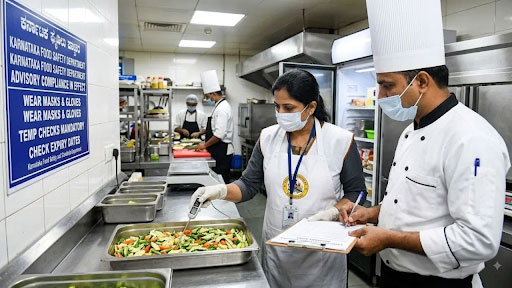
The issue erupted when a joint team led by the district health officer and district food safety officers conducted a surprise inspection at a KFC outlet situated inside a mall on K S Rao Road. Acting on complaints regarding contaminated food, officials discovered meat allegedly stored for six to eight months in the storage unit, along with expired cooking oil.
Authorities immediately seized samples, temporarily halted operations, and directed the outlet to dispose of the contaminated stock while conducting a thorough deep-clean. The seized samples were dispatched to the state food testing laboratory in Mysuru for detailed analysis, with legal action pending the final report. Meanwhile, health authorities emphasised that regulatory enforcement will spare no establishment, regardless of its commercial stature.
Following the action at KFC, food safety teams also visited a nearby McDonald's outlet under the supervision of district food safety officer Dr Praveen. The inspection focused on kitchen sanitation, storage practices, refrigeration protocols, and overall adherence to food safety standards, signalling broader regulatory vigilance across the city.
The illusion of premium dining
Consumers readily spend hundreds of rupees on a single burger or a plate of fried chicken. Polished interiors, uniformed staff, sleek packaging, and gleaming counters often create an instinctive impression of hygiene and quality. There exists a widespread assumption that high prices equal safety and that global branding equals trust.
Yet, when dining out, consumers rarely examine the questions they prioritise at home. While domestic cooking involves checking the freshness of meat, the clarity of water, and the cleanliness of utensils, commercial kitchens remain largely concealed. Crucial factors such as cold-chain maintenance, cross-contamination prevention, the reuse frequency of cooking oil, staff hygiene, pest control, and raw-material expiry records remain hidden from the diner's view. A pleasant dining ambience is not a substitute for microbiological safety.
Systemic challenges and the influencer economy
The Mangaluru incident illustrates two parallel truths. First, specific violations must face strict legal accountability under the Food Safety and Standards Act, 2006. Second, a single breach should not lead to blanket generalisations about an entire brand without official lab verification. However, it raises an unavoidable institutional question: why must food safety actions rely almost entirely on consumer complaints, viral videos, or post-incident raids rather than proactive, continuous surveillance?
This issue is compounded by the modern influencer culture. Food vloggers frequently declare eateries as "must-visit" based purely on flavour and presentation. While influencers can share personal culinary experiences, their endorsements do not equal laboratory-tested safety certificates. Food safety is a scientific reality, not a subjective review.
Institutional responsibilities and consumer rights
Ensuring safe food requires moving beyond sporadic raids toward a structured, risk-based inspection system. Authorities must implement surprise audits, laboratory testing of random samples, strict cold-chain monitoring, and thorough verification of raw-material batch records.
Moreover, transparency needs modernisation. Establishing public-facing mechanisms, such as QR codes displayed at restaurant counters that reveal valid FSSAI registration, hygiene ratings, and past inspection records, would empower consumers to make informed choices.
At the same time, food safety must remain strictly brand-neutral. Large corporations bear a massive responsibility due to their wide customer base, but street vendors, small canteens, bakeries, and high-end restaurants must all be held to identical safety standards. For working professionals, students, drivers, and migrant workers, dining out is often a daily necessity rather than a luxury.
Food safety is not merely about counting calories or following diet trends; it is a vital pillar of public health. While business owners have the right to earn a profit, they hold an uncompromised duty to protect customer well-being. Ultimately, consumers must actively exercise their right to question food safety rather than settling for taste alone, ensuring that commercial profits are never prioritised over human health.