El Niño: Coastal Karnataka faces heat, 29% rain deficit threatens paddy crop


Daijiworld Media Network - Mangaluru

Mangaluru, Sep 24: The El Niño effect has led to a significant decline in the normal rainfall across the country, with the coastal region recording a 29% rainfall deficit. As a result, the ground has already begun heating up in September, and preparations to face drought conditions may have to begin now.

Severe drought conditions have been reported in 57 taluks across 25 districts of the state, while moderate drought has been reported in 45 taluks. The coastal region, which normally receives abundant rainfall and frequently experiences flooding, has not witnessed floods this year. In Dakshina Kannada district, the normal rainfall by the end of September is 3,528.0 mm, whereas the district has received only 2,505.9 mm this year, resulting in a 29% rainfall deficit.
 

In 2017-18, Mangaluru and Bantwal were among the drought-affected areas, while Mangaluru and Moodbidri were on the list in 2023-24. This year, Beltangady has recorded a rainfall deficit of 1,345 mm, Bantwal 1,189 mm, Mangaluru 1,225 mm, Puttur 1,496 mm, Sullia 310 mm, Moodbidri 1,123 mm, Kadaba 561 mm, Mulki 1,518 mm and Ullal 1,033 mm. Among these, Beltangady, Mangaluru and Mulki have recorded the highest rainfall deficits.

Dakshina Kannada district has recorded a 29% rainfall deficit. According to the central government's drought management guidelines, a district is considered drought-affected when the rainfall deficit reaches 33%. Weather department experts say that if the coastal district does not receive adequate rainfall during the post-monsoon season as well, it is certain to be declared drought-affected.

Normally, at least three to four spells of heavy rain occur between June and August, resulting in floods. However, this year, flooding occurred only once following a spell of heavy rain. The drizzle that usually occurs during the Aati month increases the water seepage and groundwater recharge, but this year, the water seepage has already declined.

The heat and warmth of the soil normally experienced in March have been witnessed as early as September this year, causing further concern.

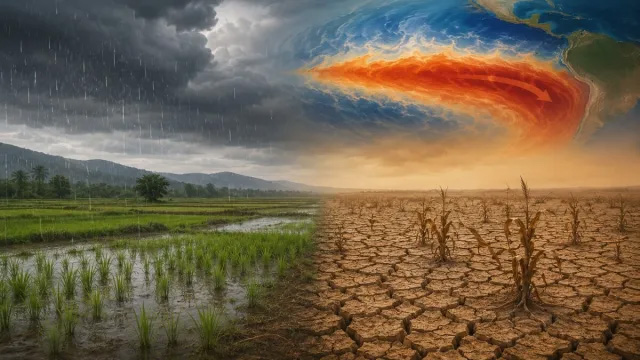
Considering the coastal climate, paddy crops require heavy rainfall during August and September. When abundant rainfall is received during these months, farmers expect a good harvest. However, adequate rainfall has not been received during August and September this year.

As a result, the paddy crop, which normally remains lush green, has changed colour and begun to appear scorched. The paddy ears, which should have sprouted and bent under their weight, have not shown the expected growth this year. Moreover, paddy cultivation itself has declined by around 40-50% compared to normal this year.


Top Stories

Comment on this article

  • Joseph, Bombay

    Fri, Sep 25 2026

    A cascading string of repercussions, with glaring and far-reaching consequences that are likely to haunt us for years to come.

    DisAgree Agree [7] Reply Report Abuse

  • Shashi Shetty, Santhoor

    Fri, Sep 25 2026

    Our present dilemma is largely of our own making a consequence of greed, unnecessary prestige, and our endless desire for more. Our responsible ancestors preserved these beautiful lands, forests, streams, and ponds as a living inheritance. Today, we are destroying them for additional wealth and luxuries, even when most of our basic needs are already met. We cut down forests that protected our soil and retained moisture. We expose the land to harsh sunlight, allow streams and ponds to disappear, and watch fertile soil wash away. When the monsoon arrives, precious rainwater runs off instead of being absorbed and retained by the land. We are not merely selling our land; we are dismantling the natural systems that sustain it. For what? A little more money, a bigger house, or comforts we can live without? Our land is not just property. It is an inheritance preserved by generations before us and a responsibility owed to those who come after us. Let us not be the generation that inherited a beautiful land and left behind a depleted one. True prosperity lies not only in what we accumulate, but in what we preserve.

    DisAgree [1] Agree [15] Reply Report Abuse

  • Anil Hegde, Mangaluru

    Fri, Sep 25 2026

    Ver well said sir. True prosperity lies not only in what we accumulate, but in what we preserve.

    DisAgree Agree [6] Reply Report Abuse

  • geoffrey, hat hill

    Sat, Sep 26 2026

    Just last year we had the best rains in 5 decades. All that changed within a year?

    DisAgree Agree Reply Report Abuse


Leave a Comment

Title: El Niño: Coastal Karnataka faces heat, 29% rain deficit threatens paddy crop


You have 2000 characters left.

Disclaimer:

Please write your correct name and email address. Kindly do not post any personal, abusive, defamatory, infringing, obscene, indecent, discriminatory or unlawful or similar comments. Daijiworld.com will not be responsible for any defamatory message posted under this article.

Please note that sending false messages to insult, defame, intimidate, mislead or deceive people or to intentionally cause public disorder is punishable under law. It is obligatory on Daijiworld to provide the IP address and other details of senders of such comments, to the authority concerned upon request.

Hence, sending offensive comments using daijiworld will be purely at your own risk, and in no way will Daijiworld.com be held responsible.