Daijiworld Media Network - Chikkamagaluru
Chikkamagaluru, Oct 7: For 50-year-old Jubedha, public service extends far beyond her official positions as president of the Narasimharajapura Municipality, secretary of the Kannada Sahitya Parishat and author of two poetry collections.
In Narasimharajapura, she is often the person people turn to when someone is found ill, abandoned or alone. She takes them to hospital, traces their families and, when relatives cannot be found, arranges shelter or the final rites. Over the years, Jubedha has helped conduct around 106 funerals, donated blood 56 times and helped around 1,000 women acquire skills to earn a livelihood.
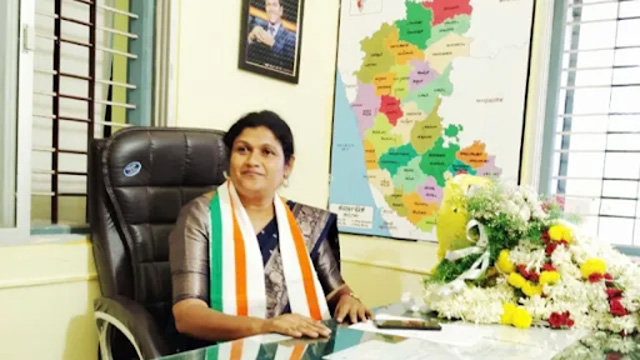
Her motivation stems from personal experience. She grew up in a financially struggling family and later raised two daughters alone after her husband left. The hardships she endured, she says, shaped her determination to ensure that others do not have to face difficult times without support.
Jubedha was the eldest of five daughters. Her father, a driver, struggled to make ends meet. The sisters often shared clothes and footwear, while even small celebrations were beyond the family's means. Yet her father refused to allow poverty to limit his daughters. He taught Jubedha to ride a bicycle and encouraged her to learn skills that people in the neighbourhood considered suitable only for boys. When neighbours questioned why he was teaching a girl to cycle, he would simply ask what was wrong with it.
“That spirit has stayed with me,” she says.
Her commitment to helping others began taking shape while she was still a schoolgirl. In Class 6 or 7, she would wake before dawn to help neighbours observing Ayyappa rituals. As they did not cook at home during their observances, she would go to their houses, prepare food and assist with prayers before returning home.
“There was no distinction between people based on caste or religion. We all lived together and supported each other. That is how my parents brought us up,” she says.
That early lesson would later become the foundation of her community work.
Jubedha married and had two daughters, but her husband left when the children were still young. She suddenly found herself raising them alone, shouldering both the financial responsibility and the social judgement that often accompanies a woman living independently.
She took up whatever work was available. She worked during election campaigns and political programmes, accompanying women to events for modest payments. It was work driven by survival, aimed simply at keeping her household going. But those assignments brought her into contact with an increasing number of people and gradually drew her towards social service.
“When a woman is alone, she has to hear a lot from society. I have gone through that. I know what hardship is and what it means to survive without depending on someone,” she says.
Her own experience made Jubedha acutely aware of the vulnerability women face without an independent income. In 2012, she became involved with the Mahila Samaj, helping women acquire skills that could provide them with a livelihood.
Over the years, women have received free training in tailoring, mehendi, beauty and grooming, and embroidery. Jubedha estimates that around 1,000 women have benefited from the programmes. For many of them, the training has meant moving from dependence on others to being able to support their own families.
“I have struggled a lot to raise my children. I don’t want another woman to go through the same experience. A woman should be able to stand on her own feet and earn for herself,” she says.
For Jubedha, social service is not merely about providing immediate assistance. It is also about helping people become capable of supporting themselves. The livelihood she once had to struggle to secure has become something she now helps other women build, free of charge.
Her work extends well beyond women's training programmes. She continues to help people who are ill, elderly, abandoned or without family support. When she comes across someone left without care, she tries to get them admitted to hospital, trace their relatives and, where possible, reunite them with their families. When relatives cannot be located, she helps arrange shelter.
During the Covid-19 pandemic, when fear kept many people indoors, Jubedha got behind the wheel of an ambulance and drove people requiring medical care to hospital.
She has also helped those who died without anyone to claim them. Around 106 funerals have been conducted with her assistance for people without relatives, with the last rites carried out according to their respective religious customs.
She has donated blood 56 times and, for nearly two decades, has been associated with a shelter for people living with mental health conditions. She assists residents with hospital visits and other needs and also helps arrange funerals when a resident dies.
Much of this work takes place away from public attention. For Jubedha, however, it is simply an extension of a principle she learnt at home: no one should be left alone when they need help.
That principle is also evident every year during Ganeshotsava. Jubedha has helped organise the festival for the past 18 years and has been unanimously elected president of the committee that conducts it. The committee oversees the installation of the idol, rituals and other programmes.
Known as ‘Bhavaikya Ganapathi’, the festival draws people from different communities.
“Everyone comes. Muslims, Christians and Hindus all participate. Nobody asks why I am organising Ganapati because they know that I intend to bring people together,” she says.
Jubedha is also involved in programmes associated with Holi, Deepavali and Karthik Deepotsava. She believes the impact extends beyond the celebrations. When children grow up watching neighbours participate in one another's festivals, they learn that religious differences need not lead to separation, she says.
It is the same lesson she absorbed as a schoolgirl while helping neighbours with their rituals — and one she now hopes to pass on to the next generation.
Jubedha's community work has since expanded into a public role. She is currently the president of the Narasimharajapura Municipality and, since 2024, has served as secretary of the Kannada Sahitya Parishat.
Her literary interests have continued alongside her social work. She has authored two poetry collections (Kavana Sankalana), written in 2001 and 2013.
Her service has earned her several honours, including the Corona Warrior Award, Nagarika Seva Prashasti, Udaya Kannadiga Prashasti, Kannada Rajyotsava Prashasti and the Junior Mother Teresa Award, recognising her social service, civic contribution and work in Kannada.
But recognition, she says, is not what motivates her.
“I have seen a lot of pain in my life. But I have chosen to find my happiness in making other people happy,” she says.
A childhood marked by scarcity and the experience of raising two daughters alone did not end with survival for Jubedha. Instead, those experiences became the foundation for a life spent ensuring that others have someone to turn to — whether they are women seeking a livelihood, patients without support, people abandoned by their families or neighbours simply looking for a community that will stand by them.