Daijiworld Media Network - Ponda
Ponda, Oct 20: Goa’s Scheduled Tribes (ST) community has warned of a statewide democratic campaign if political reservation in four Assembly constituencies is not implemented before the 2027 Assembly elections.
The warning was issued at an awareness meeting held at Khaddem–Balli, attended by around 150 people from Balli–Adnem Panchayat and ST leaders from various parts of Goa.
The meeting discussed political representation, tribal welfare, pending government vacancies, forest rights, agricultural livelihoods and rural infrastructure.
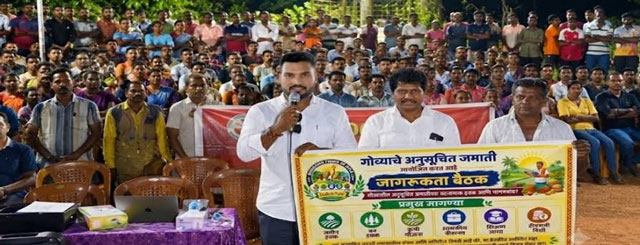
Ami Goeche Rakhhandar president Rama Kankonkar said the community had been fighting for political representation for decades and had conducted more than 130 awareness meetings across Goa.
“If they (the BJP government) again try to cheat us and don’t give political reservation before the 2027 Assembly election, the ST community will revolt against this government through the democratic process. We will go to every village and create awareness about how we have been denied our rights,” Kankonkar said.
He warned that any further delay in fulfilling the community’s constitutional rights would trigger a united democratic response. Goa has approximately 1.80 lakh ST voters across 22 Assembly constituencies, he said, urging tribal youth to actively participate in the campaign.
Convenor Rupesh Velip questioned the utilisation of approximately Rs 33.37 crore reportedly spent on tribal programmes between 2024 and 2026 and demanded transparency and measurable benefits for beneficiaries.
He stressed that tribal development must translate into better roads, drinking water, drainage, irrigation, healthcare and other essential facilities.
The meeting also highlighted more than 2,500 pending backlog vacancies for ST candidates in government departments and over 9,500 pending Individual Forest Rights claims.
Participants demanded the notification of eligible tribal areas under the Fifth Schedule of the Constitution, transparent utilisation of Tribal Sub-Plan funds, and protection of tribal lands and traditional livelihoods.
Dheeraj Talpekar of Cola, Quepem, explained various welfare schemes available to ST beneficiaries but pointed out that complicated online applications, documentation requirements and administrative delays often prevent eligible families and students from accessing them. He called for village-level Seva Camps and simplified application procedures.
Women’s Wing Coordinator Harsha Wadkar expressed concern over development projects affecting tribal lands, biodiversity, water bodies and cultivated areas. She urged educated tribal youth to spread awareness, monitor welfare projects and hold authorities accountable, emphasising the need to protect indigenous traditions and community rights.
Participants also demanded time-bound action on rural infrastructure, agricultural assistance, employment and welfare schemes. They urged elected representatives and government officials to visit remote tribal villages and prepare development plans based on local needs.
The meeting was attended by ST representatives from Quepem, Ponda, Sanguem, Canacona, Cuncolim, Curchorem, Cacora and Salcete, among other areas. Several local leaders and village coordinators helped organise the gathering.