Daijiworld Media Network - Panaji
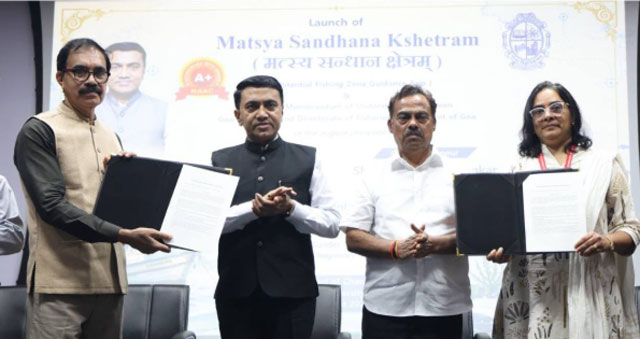
Panaji, Aug 10: Chief Minister Pramod Sawant on Monday urged universities to use research and technology to address local challenges as Goa University launched Matsya Sandhan Kshetram, a Potential Fishing Zone (PFZ) guidance application developed for the state's fishing community.
The app uses satellite observations and oceanographic data, including sea surface temperature, ocean colour and chlorophyll concentration, to identify areas where fish are more likely to aggregate. It provides fishermen with the location, distance and coordinates of potential fishing grounds, helping reduce search time, fuel consumption and operational costs.
The application also offers a seven-day sea-condition forecast, including significant wave height and wind conditions. It is available in Konkani, Marathi, Hindi and English, with access currently restricted to phone numbers registered in Goa.
Speaking at the launch, Sawant said universities should develop solutions to real-world problems instead of relying heavily on external consultants. He said the approach should extend to agriculture, dairy, tourism, healthcare, renewable energy, water resources and disaster management.
Fisheries Minister Nilkanth Halarnkar said the technology could benefit thousands of families dependent on fishing amid rising fuel costs, fluctuating catches, changing ocean conditions and extreme weather. He, however, urged fishermen to use the app alongside official weather and navigation advisories.
Goa University Vice-Chancellor Prof Harilal D Menon said the application is the result of years of research and is powered by the Goa University Case 2 Water Algorithm (GC2), which processes satellite data to generate PFZ maps.
According to Menon, the project is being taken forward as a potential blue-tech startup through the Goa University Research Park Unit (GURPU). An MoU between Goa University and the Directorate of Fisheries was also signed during the programme.
The university plans to conduct awareness programmes and training sessions for fishermen at harbours, jetties and landing centres, while feedback from fishermen will be used to further improve the technology.