Daijiworld Media Network - Panaji
Panaji, Aug 11: The State Council of Educational Research and Training (SCERT) has introduced a competency-based and holistic assessment framework for students from Grades I to VIII from the current academic year, replacing the conventional marks-focused report card with a Holistic Progress Card (HPC).
The revised system moves away from an examination-centric approach and places greater emphasis on students' conceptual understanding, practical application, critical thinking, creativity and life skills. Schools have been directed to assess students through rubrics, portfolios, projects, classroom observations, self-assessment and peer assessment instead of relying solely on written examinations.
Under the new framework, students in Grades I and II will continue to undergo only school-based internal assessments. Students from Grades III to VIII will be assessed through a combination of formative and summative assessments aligned with learning outcomes prescribed for each stage.
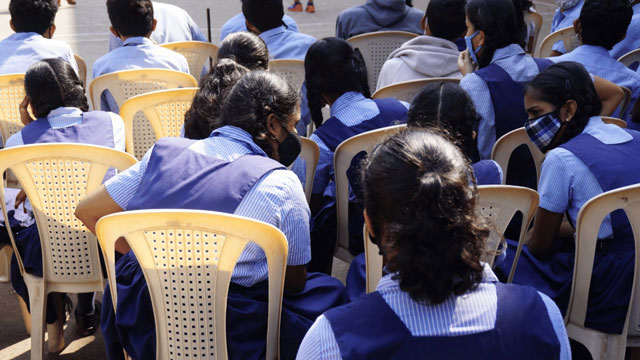
The Holistic Progress Card will provide a broader assessment of each child's academic performance, competencies, skills, participation, attitudes and overall development. In line with the National Education Policy (NEP) 2020, the card will capture students' cognitive, social, emotional and physical growth, giving teachers and parents a more comprehensive picture of their learning journey instead of focusing only on examination marks.
SCERT has prescribed competency-based question papers with greater emphasis on application-oriented questions and reduced focus on rote learning. Teachers have also been instructed to maintain student portfolios throughout the academic year, documenting academic progress, co-curricular achievements and socio-emotional development.
The guidelines prescribe detailed assessment rubrics for the foundational, preparatory and middle stages, allowing teachers to measure students' progress against defined competencies rather than merely awarding marks. Communication, collaboration, problem-solving, values and attitudes will also form part of the assessment in accordance with NEP recommendations.
Schools have been directed to provide regular feedback to students and parents, identify learning gaps at an early stage and use assessment findings to plan remedial teaching. The framework is part of Goa's expanded implementation of NEP 2020.
The introduction of the new assessment system comes at a time when the state is yet to take a final decision on discontinuing the no-detention policy. Earlier this year, the government decided to continue the policy for Classes V and VIII for the 2026-27 academic year while awaiting detailed implementation guidelines following changes to the Right to Education Rules.