Daijiworld Media Network – New Delhi
New Delhi, Aug 13: A parliamentary panel has raised concerns over inadequate preparation for implementing the three-language formula from Class 6, saying delays in teacher recruitment, shortage of study materials and uncertainty over language choices have placed additional pressure on students, teachers, parents and school authorities.
The observations were made in the Tenth Report of the Committee on Estimates (2026-27), titled ‘Budget and Policy aspects for providing Affordable and Quality Education in the Country including Review of Central Board of Secondary Education’, which was tabled in the Lok Sabha on Wednesday.
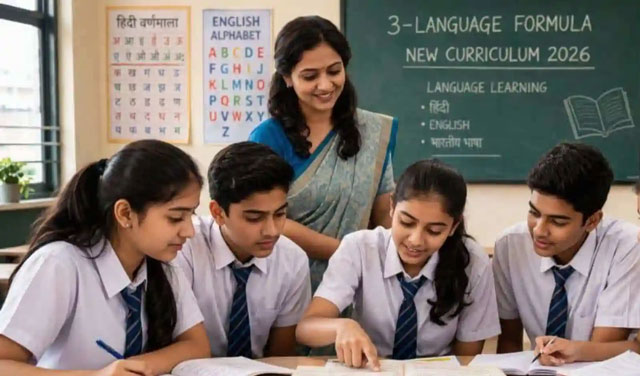
The committee acknowledged the efforts of the Union Ministry of Education to promote multilingual education and mother-tongue-based learning under the National Education Policy (NEP) 2020. It noted that the ministry has worked with state and Union Territory governments and specialised institutions to implement reforms, including the flexible three-language formula and the R1-R2-R3 language framework.
The panel also highlighted progress in making educational resources available in multiple Indian languages. Textbooks for subjects such as mathematics, science and social sciences have been translated into all 22 scheduled languages, while bridge courses and digital content have been developed to support students during curriculum transitions.
Initiatives such as the ‘Jaadui Pitara’ play-based learning kits in 22 languages, the Bhasha Sangam programme and 121 mother-tongue primers prepared with the Central Institute of Indian Languages were also highlighted.
Despite these measures, the committee said the practical requirements for implementing the three-language policy had not been adequately anticipated, particularly with regard to teaching materials, teacher training and recruitment.
The panel observed that schools had not been given sufficient time to prepare for the introduction of the third language from Class 6, resulting in stress among students, teachers, parents and school authorities.
The committee urged the Ministry of Education to accelerate the preparation and translation of textbooks, supplementary learning materials and handbooks and ensure their timely distribution to states and Union Territories.
It also recommended supporting state and UT education boards in recruiting teachers capable of teaching in native languages, particularly during the foundational and preparatory stages.
The panel further called for a robust state-wise distribution mechanism to ensure that translated textbooks, multilingual digital content and ‘Jaadui Pitara’ kits reach every rural and government school before the start of each academic session.