Daijiworld Media Network - Hyderabad
Hyderabad, Aug 21: The story of what began as an idea between two former ISRO engineers has now grown into a company employing around 1,000 people.
Scoring 51 marks in mathematics may not seem like the typical beginning of a rocket scientist’s journey. Yet, this is where the story of Pawan Kumar Chandana began. Today, the Vikram-1 rocket developed by him has made history by becoming the first privately developed Indian rocket to reach space.
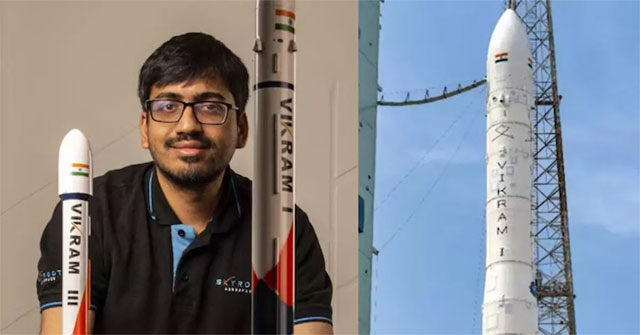
Behind Vikram-1 is Skyroot Aerospace, the startup co-founded by Chandana. Years before becoming the co-founder and CEO of one of India’s largest private rocket manufacturing facilities and helping launch the country’s first privately built rocket, Chandana was a student struggling to find his footing academically.
He was not a rank-holder in mathematics. However, he made up for his shortcomings in academics with curiosity, hard work and a fascination with machines. In June 2018, Chandana and his co-founder, former ISRO engineer and IIT Bombay graduate Bharat Daka, founded Skyroot Aerospace in Hyderabad.
Born and raised in Hyderabad, Chandana grew up in a middle-class family. Like millions of other Indian students, he spent much of his early years exploring machines and technology. His father’s encouragement never wavered despite the difficulties he faced. The subjects that initially troubled him in academics gradually became areas of interest. Mathematics and science went on to form the foundation of his future career.
Around two decades ago, Chandana cleared the IIT entrance examination on his first attempt and joined IIT Kharagpur. For many students, this achievement itself would have been enough. But for Chandana, it was only the beginning. While many engineering graduates pursued lucrative careers in the technology sector, his focus remained on space and rockets. This interest eventually took him to the Indian Space Research Organisation (ISRO). He joined ISRO directly from the IIT Kharagpur campus.
The job did not offer the kind of salary available in private companies. However, it gave him an opportunity to work on India’s space programme. At ISRO, Chandana worked on the GSLV Mk III project. He also received an internal innovation award for his work. He spent six years at the Vikram Sarabhai Space Centre in Thiruvananthapuram, gaining experience in rocket design and development.
Meanwhile, India’s startup ecosystem was expanding rapidly. It was during this period that he came up with the idea of developing rockets outside the traditional government institutions. Speaking to the media in 2023, he said, “The private sector has been involved in the space sector for two years now. We have a great opportunity over the next 10 years.”
However, starting a private space company was not an easy proposition. Funding was a major challenge, and investors were not interested. Chandana’s first major support came from Flipkart co-founder and IIT Kharagpur alumnus Binny Bansal, who invested $1.5 million. However, the Covid pandemic hampered the company’s growth. During that period, Greenko provided financial support.
In July 2020, Skyroot became the first private Indian company to successfully test a rocket engine. The engine, named Raman-1, marked a significant milestone for the young startup. The following year, after the Indian government opened the space sector to private participation, Skyroot entered into an agreement with ISRO and raised $51 million.
For Chandana, success was not merely about financial valuation. The breakthrough he had been seeking came in November 2022 with the launch of Vikram-S. It was a sub-orbital rocket.
What began as an idea between two former ISRO engineers has now grown into a company employing around 1,000 people.