Daijiworld Media Network - New Delhi
New Delhi, Sep 10: Robot-assisted stroke rehabilitation significantly improved upper limb motor recovery compared with conventional cognitive rehabilitation in patients with chronic stroke, according to a randomised controlled trial.
The single-centre exploratory study involved 30 stroke patients who were randomly assigned to an intervention group and a control group, with 15 participants in each.
The intervention consisted of robot-assisted integrated cognitive-motor training using an end-effector system. The sessions combined goal-directed reaching exercises with tasks designed to engage attention, memory and executive function.
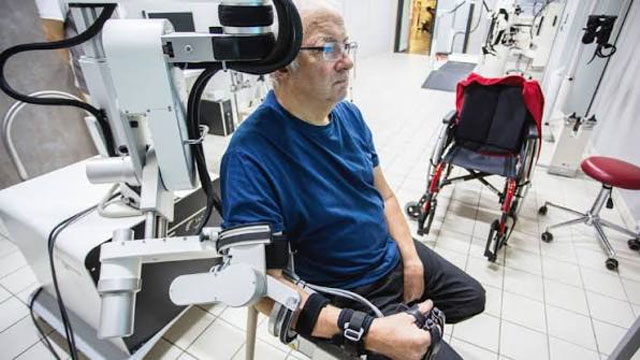
Participants underwent 10 sessions of 30 minutes each over three weeks. The control group received conventional paper-based cognitive rehabilitation for the same treatment duration and dose.
Researchers assessed global cognitive function using the Korean Mini-Mental State Examination (MMSE) and Korean Montreal Cognitive Assessment (MoCA). Secondary assessments included cognitive subdomains, upper limb motor function and functional independence.
Both groups showed significant improvements in MMSE and MoCA scores. However, there was no statistically significant difference between the two groups in either measure.
Similar findings were observed in the secondary cognitive assessments. Although both groups showed improvements in several Cognitive Assessment Screening Test (CERAD) subdomains, the differences between the groups were no longer statistically significant after adjustment using the False Discovery Rate method.
The clearest difference was seen in upper limb motor recovery. Scores on the Fugl-Meyer Assessment of the Upper Extremity (FMA-UE) increased from 33.6 to 37.5 in the robot-assisted group, compared with a change from 25.7 to 25.9 in the control group.
The between-group difference was statistically significant, with a p-value of 0.012 and Cohen's d of 0.98.
The researchers concluded that robot-assisted integrated cognitive-motor rehabilitation was feasible and safe for patients with chronic stroke. While cognitive improvements were comparable to those achieved through conventional rehabilitation, the robot-assisted approach was associated with better upper limb motor recovery.
The findings suggest that combining cognitive tasks with goal-directed motor training could support motor rehabilitation after stroke. However, researchers noted that the small sample size and exploratory design limit the findings, and larger trials are needed to determine whether the approach can provide additional cognitive benefits over conventional rehabilitation.