Daijiworld Media Network - Mumbai
Mumbai, Oct 25: Climate activist and educationist Sonam Wangchuk on Saturday said peaceful protests serve as a feedback mechanism for governments and help them perform better, citing unrest in Nepal, Sri Lanka and Bangladesh as examples of what can happen when people are denied the opportunity to express their concerns peacefully.
Speaking at the IPF Festival in Mumbai, Wangchuk said protests should be allowed near centres of power rather than being pushed to distant locations. He pointed out that countries such as the United Kingdom, Norway and Sweden permit demonstrations outside their parliaments.
“In India, it was far from Parliament. Even when it was just Jantar Mantar in New Delhi, it was too far,” he said, describing peaceful protests as a pressure valve that allows governments to understand public concerns and improve their performance.
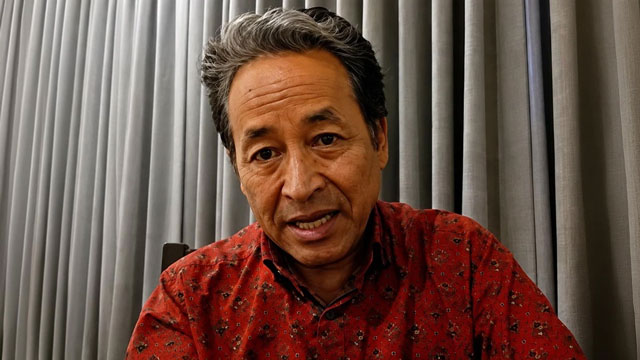
His remarks came amid the Centre's action against protesters after the Cockroach Janta Party (CJP) called for a demonstration at Jantar Mantar, demanding the resignation of Chief Election Commissioner Gyanesh Kumar over alleged irregularities in the Special Intensive Revision of electoral rolls. Opposition parties have criticised the Union government over restrictions on peaceful protests.
“Look what happens when protests are not allowed. That is the example of Sri Lanka, Bangladesh, Nepal, when peaceful venting of energy is not allowed,” Wangchuk said.
He argued that people should not need permission to stage peaceful demonstrations, adding that regulatory mechanisms should primarily help authorities monitor public gatherings and events. He described peaceful street protests as a constitutional right and, referring to the arrests of demonstrators, including CJP leaders, said, “You don't kill the messenger. Take the message.”
Wangchuk had earlier undertaken a 26-day hunger strike in support of the CJP's demand for the resignation of then Union Education Minister Dharmendra Pradhan over alleged irregularities in the NEET examination. He said governments risk alienating people when they take actions that are unnecessary or fail to address public concerns.
“If you do things that need not be done, then people will go against you. This will only hurt the government. Do what is right,” he said.
The activist also criticised the deployment of paramilitary forces against protesters, questioning why such forces were being used against citizens, particularly young people. He said the forces, which come under the Union Ministry of Home Affairs, should focus on protecting the country's borders.
Wangchuk expressed concern over what he described as China's gradual movement into areas along the Ladakh border when attention and personnel were diverted to internal security duties, particularly during winter. He claimed that delays in responding to such developments could make it more difficult to regain control of affected areas.
“If the MHA wants to target civilians, then borders should be handed over to the Ministry of Defence,” he said, arguing that national security should remain the government's top priority.
His comments came after the Ladakh administration defended its decision to cancel the land allotment to the Himalayan Institute of Alternatives, Ladakh. The administration cited Wangchuk's alleged disregard for the law and said the allotment had lapsed because dues remained unpaid and the lease deed had not been executed.
Wangchuk also called for greater democratic participation by the people of Ladakh in decisions affecting their region. He said residents should have a say in how their land and resources are managed because they understand the local environment and bear the consequences of administrative decisions.
“And going by that principle, I say Ladakh should have a say in how Ladakh is managed. That is all we are saying, basically,” he said.
He called for a system in which local residents or their representatives could make decisions while keeping the long-term interests of future generations in mind. Referring to Ladakh's administrative status following the 2019 reorganisation of Jammu and Kashmir, he compared the region's governance to that of a former colony administered by a viceroy from New Delhi rather than London.
Wangchuk said administrators from other parts of the country might have good intentions but could lack an understanding of Ladakh's distinctive ecology and local needs.
“Just as I would be the most unfit person to become the leader or chief minister of Maharashtra, similarly, somebody from Delhi will not be the fittest and best caretaking person for Ladakh,” he said.
Wangchuk was placed under preventive detention in September 2025 following violent protests in Ladakh. He was detained under the National Security Act until his release in March 2026.
His remarks highlighted the importance of peaceful protest, the role of security forces in safeguarding the country's borders and his demand for greater democratic participation for Ladakh's residents.