Daijiworld Media Network - Jerusalem
Jerusalem, Nov 3: Israeli Prime Minister Benjamin Netanyahu is reportedly pressing US President Donald Trump to launch another wave of military strikes against Iran immediately after Tuesday's US midterm elections, even as diplomatic efforts to end the conflict show signs of progress.
According to two regional officials and another person familiar with the matter, Netanyahu is working with senior officials in the Trump administration to persuade Washington to approve a swift but extensive air campaign against Iran. However, Trump has not committed to fresh military action and appears inclined to allow ongoing diplomatic efforts to continue.
The renewed push for military action comes at a politically sensitive time for Netanyahu, whose Likud-led coalition and far-right allies lost their parliamentary majority in last week's Israeli elections. A fresh confrontation with Iran could potentially help him rally political support and form an emergency government by highlighting national security concerns.
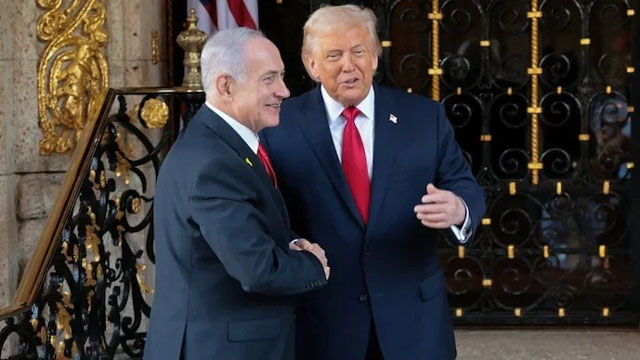
Netanyahu reportedly pressed Trump to consider renewed strikes during a telephone conversation over the weekend. However, the US president did not agree to military action. Trump later described the conversation as 'very good', confirming that Iran was among the issues discussed.
Meanwhile, diplomatic efforts led by Qatar are continuing to prevent another major escalation. Qatari mediators held two rounds of discussions with Iranian officials last week and are working towards a possible framework under which Tehran would stop attacks in the Strait of Hormuz in return for Washington lifting its blockade on Iranian ports.
Further discussions are expected this week. The regional officials said negotiations had made progress, although significant differences remain between the two sides.
Other US allies in the Middle East have cautioned Washington against renewed military action, warning that another round of strikes could destabilise the region further. They fear that Iran-aligned Houthi rebels in Yemen could intensify attacks on Saudi Arabia and commercial shipping in the Red Sea, while Iran-backed militias in Iraq could also enter the conflict.
US Secretary of State Marco Rubio, speaking at a news conference on Saturday, declined to predict Washington's next move but reiterated that the Trump administration preferred a diplomatic settlement.
"He hasn't made a decision," Rubio said, referring to Trump. He added that the president would prefer to resolve the crisis through diplomacy but had considerable confidence in military action if necessary.
Netanyahu has not publicly commented on the possibility of renewed strikes since the Israeli elections. Neither the Israeli government nor the White House immediately provided details of the latest discussions between the two leaders.
The diplomatic standoff has also exposed differences among regional powers. Qatar has been actively pursuing negotiations, while Israel is reportedly pressing for a military solution. Andreas Krieg, a professor at King's College London and former adviser to Qatar's military, described the situation as a growing divide between Qatar's diplomatic approach and Israel's preference for military action.
Iran, meanwhile, has indicated that it remains prepared for both negotiations and a possible return to war. The country's new Supreme Leader, Ayatollah Mojtaba Khamenei, recently met senior military commanders and called for an immediate response to any threat from the United States or Israel, regardless of its nature or geographical location. He also urged the military to expand its list of potential targets.
Khamenei has not appeared publicly since the opening US-Israeli strikes on February 28 killed his father, the previous Supreme Leader.
A recent analysis by The Associated Press found that Iranian attacks on more than two dozen US military bases since the beginning of the conflict had caused billions of dollars in equipment damage.
Iran's security chief Mohsen Rezaei, speaking to state television, said the tone of communications from Washington had changed significantly, describing it as a positive indication. He also acknowledged receiving a letter from US Vice-President JD Vance but did not disclose its contents or indicate whether Tehran had responded.
Tensions have also continued to affect international shipping. October recorded the highest number of attacks on commercial vessels in the Strait of Hormuz since March, as Iran sought to increase economic pressure on Washington and force it to lift restrictions on Iranian ports.
The growing uncertainty was evident at the Manama Dialogue, an annual security conference organised by the International Institute for Strategic Studies in Bahrain. UAE presidential adviser Anwar Gargash warned that the positions of Washington and Tehran remained far apart and cautioned that failure to bridge the differences could lead to a dangerous escalation.
Gulf countries have significantly increased defence spending since the conflict began. Egyptian Foreign Minister Badr Abdelatty warned at the gathering that another escalation would be more dangerous and destructive and would not produce a meaningful solution.
Meanwhile, China has stepped up its diplomatic engagement in the region. Chinese Foreign Ministry spokesperson Mao Ning announced that Beijing would send a special envoy to Iran, Oman and Saudi Arabia in early to mid-November to discuss regional developments.
Chinese President Xi Jinping, in discussions with Oman's Sultan, stressed that the Gulf region should not become an arena for geopolitical rivalry and confrontation among major powers. China and Oman also called for a return to dialogue and diplomatic efforts to restore regional stability.
With diplomatic negotiations continuing and Netanyahu pressing for renewed military action, the coming days are expected to be crucial in determining whether the US-Iran conflict moves towards a negotiated settlement or another major military escalation.