Daijiworld Media Network - Mumbai
Mumbai, Nov 17: Nationalist Congress Party (NCP) legislators in the Maharashtra Legislative Assembly and Legislative Council on Tuesday donated one month's salary to the Chief Minister's Relief Fund to support farmers affected by drought across the state.
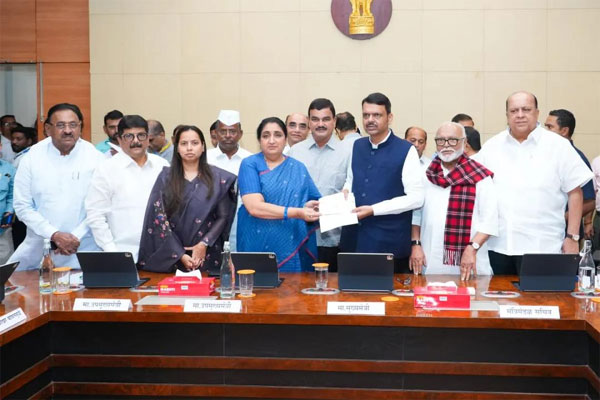
The legislators, led by NCP National President and Deputy Chief Minister Sunetra Pawar, handed over the cheques to Chief Minister Devendra Fadnavis during the state cabinet meeting at Mantralaya.
"Standing firmly with farmers during times of crisis and ensuring they receive the necessary assistance is the true lesson imparted by late Ajit Pawar," the legislators said in a press release.
Carrying forward his legacy and ideology, sharing the hardships of farmers and contributing towards resolving their difficulties was a collective responsibility, they said, reiterating the party's commitment to protecting the interests of the farming community.
Deputy Chief Minister Sunetra Pawar, veteran party leader and Food and Civil Supplies Minister Chhagan Bhujbal, Medical Education Minister Hasan Mushrif, Cooperation Minister Babasaheb Patil, Food and Drug Administration Minister Narhari Zirwal, Agriculture Minister Dattatray Bharne, Women and Child Development Minister Aditi Tatkare and senior legislator Shivajirao Garje were among those present.
Meanwhile, in view of the emerging drought and severe water scarcity across Maharashtra, the state government has undertaken a series of measures through Government Resolutions (GRs), circulars and directives issued between October 5 and November 6.
The government has declared drought in 304 talukas due to deficient rainfall and decentralised administrative powers to expedite relief measures. It has also fast-tracked water and soil conservation projects, prioritised fodder availability for livestock and established district- and taluka-level coordination committees.
Taluka-level Chief Minister's Relief Fund cells and coordination committees are also being set up to ensure effective management of public health services in drought-affected areas.
For water conservation and infrastructure development, the administrative deadlines for works under the District Annual Plan (General) for 2026-27 have been extended, allowing administrative sanctions until November 30. Directives issued by the Chief Secretary have empowered local secretaries and District Collectors to expedite technical approvals.
Under the MLA Local Area Development (LAD) programme, District Collectors have been authorised to sanction drought-related and water-scarcity works costing up to Rs 25 lakh per project in both rural and urban areas. Members of Parliament have also been requested to recommend priority works under the MP LAD programme.
In 304 talukas facing Trigger-1 and Trigger-2 conditions, soil and water conservation works are being undertaken through NGOs and the VB G RAM G scheme. These include deepening and widening streams, constructing farm ponds, building recharge shafts, installing check dam gates and creating rainwater harvesting structures.
A state-level high-powered committee headed by the Chief Minister has also been constituted to monitor soil and water conservation projects.
To ensure fodder security and proper livestock management, the government is scaling up fodder production across agricultural lands, forest areas and submergence reservoir lands.
The government has fixed the base price of fodder at Rs 12 per kg and the maximum price of silage at Rs 8 per kg, excluding transportation costs.
Submergence and silt-bed lands, along with suitable forest department lands equipped with irrigation facilities, are being allocated specifically for cultivating short-duration, multi-cut fodder crops under committees led by District Collectors.
The Forest Department has suspended regular grass auctions within its jurisdiction until further notice to ensure adequate fodder availability for livestock and wildlife.
District Executive Drought Management Committees will decide on setting up fodder camps, with one camp proposed per revenue circle depending on livestock numbers and water availability.
Corporate Social Responsibility (CSR) funds will be utilised for establishing fodder depots and providing water supply, hygiene facilities, CCTV systems and balers. The government has also strictly prohibited the transportation of fodder outside state borders and its use for non-fodder purposes such as biofuel production, power generation and industrial packaging.
The government resolutions further direct schools and anganwadis to ensure the availability of clean drinking water, functional handwashing facilities and regular biological testing of water samples. Temporary tanker supplies or pipeline extensions must be arranged wherever permanent infrastructure remains incomplete.
Priority measures include deepening wells, desilting, acquiring private borewells, implementing temporary supplementary piped water supply schemes and constructing recharge shafts near water sources.
Urban and rural local bodies have also been permitted to restore disconnected electricity supplies to water schemes upon payment of a security deposit equivalent to one month's charges and reconnection fees.
New water supply connections will also be provided upon payment of standard connection charges, even in cases where previous dues remain unpaid.