Daijiworld Media Network - New Delhi
New Delhi, Nov 18: The killing of Lateef Bhat alias Mohammad Bhat, one of the most prominent Lashkar-e-Taiba (LeT) operatives in the Kashmir Valley, was the culmination of an eight-day precision operation based on actionable intelligence inputs and carried out jointly by Indian security forces.
The operation, launched on the basis of Grade A intelligence, eventually led to the elimination of Bhat and his associates following a series of terror attacks in Jammu and Kashmir.
Security forces initiated the operation after a November 11 attack on a Central Reserve Police Force (CRPF) checkpoint in Kulgam, in which three personnel were injured.
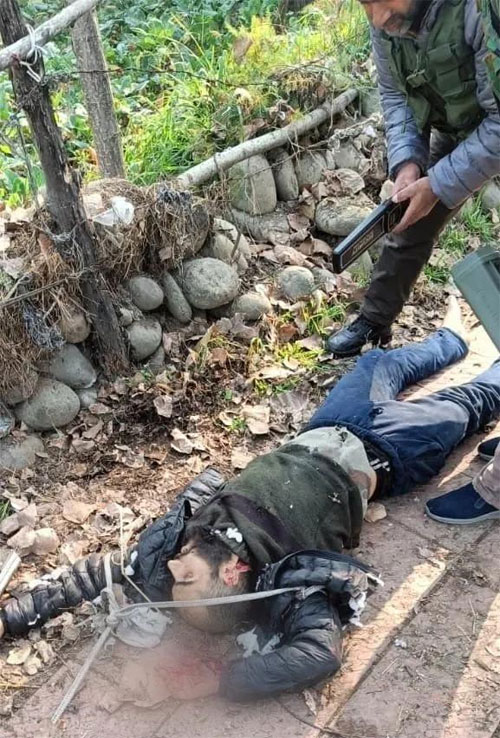
While Bhat was killed on Wednesday during a joint operation in the Zangulpora-Laru area of Kulgam, his associate Umar Nisar Dar was eliminated on November 16.
According to an official, before the November 11 attack, Bhat was also allegedly involved in the killing of Head Constable Ashiq Hussain in July and two migrant workers during the same month.
The successive attacks had increased pressure on security agencies and the government, with questions being raised over how terrorists continued to carry out strikes despite heightened security arrangements across the Valley.
There were growing concerns over the ability of terrorists to execute attacks even in areas under close security surveillance.
"Neutralising Bhat was crucial to avenge the attacks and ensure that public confidence in the security apparatus was not undermined," an official said.
Following the November 11 attack, security agencies examined surveillance footage from November 10 and 11. Investigators found that Bhat and his associate Nisar Dar had allegedly conducted reconnaissance in Mir Bazar, Akhran, Hablish and Kilam before carrying out the Kulgam attack.
Joint teams of the Indian Army, CRPF, Jammu and Kashmir Police and National Investigation Agency (NIA) subsequently cordoned off several villages in Kulgam and established multi-layered checkpoints. Security personnel also conducted door-to-door searches.
The forces combed orchards and questioned around 600 people to gather intelligence about the overground worker (OGW) network allegedly providing support to Bhat.
On Wednesday, security personnel finally cornered Bhat inside a mosque in Kulgam, where he had taken shelter.
To avoid damage to the religious structure and provide him an opportunity to surrender, senior security officers established contact with him through telephone and video calls.
When officers told him, "We are with you," Bhat reportedly responded, "I want to meet Allah."
After he refused to surrender, an exchange of fire broke out, during which Bhat was killed in retaliatory firing by security forces.
Another official said the final phase of the operation was particularly challenging as security agencies had to ensure that communal harmony was not disturbed.
"The security agencies ensured that the mosque remained unharmed and prevented any local unrest or propaganda that could have been triggered by damage to the religious structure," the official said.
An Intelligence Bureau official said Bhat had managed to evade security forces on several occasions and had gradually emerged as a major challenge for the security establishment, while also testing its operational capabilities.
The official said Bhat was increasingly being projected as a hero among certain sections of society, prompting security agencies to prevent such a perception from gaining ground.
"Such elements cannot be allowed to remain at large for long, as they can become role models for potential recruits in the Valley," the official said.
The LeT's plans to establish a fully local terror network in Kashmir reportedly depended on Bhat's continued presence and his ability to operate on the ground. His elimination is expected to deal a significant setback to the outfit's efforts.
Officials said Bhat's killing has brought the number of active local terrorists in South Kashmir down to zero.
Pakistani terrorists infiltrating the Valley depend heavily on local operatives for navigating difficult terrain, arranging accommodation and securing safe houses.
With the elimination of the last known active local terrorist commander, foreign terrorists operating in South Kashmir are expected to lose a crucial link for logistics and overground support networks.
Bhat was also allegedly attempting to recruit local youths to rebuild the LeT network. His most recent recruit was reportedly 10-year-old Umar Nisar Dar.
An official said the elimination of Bhat had brought the immediate challenge posed by local terrorist commanders to an end, allowing security agencies to concentrate their efforts on foreign terrorists and their handlers operating from Pakistan.