Daijiworld Media Network - Baghdad
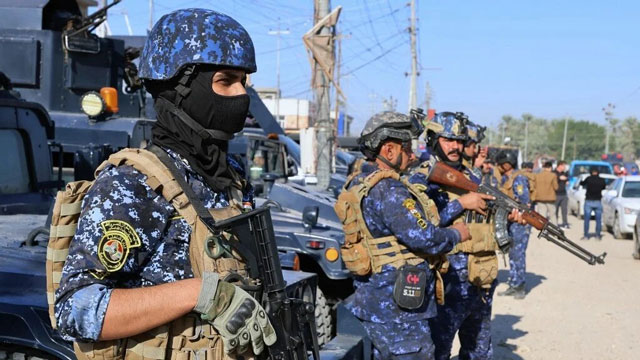
Baghdad, Nov 21: Iraqi security forces entered the stronghold of Iran-backed paramilitary group Kataeb Hezbollah in Jurf al-Sakhar, south of Baghdad, on Friday following an agreement that helped avert a potentially violent confrontation between the government and the powerful armed faction.
Local journalists reported that Iraqi police forces crossed checkpoints previously manned by Kataeb Hezbollah fighters in the strategic area. State media confirmed that joint Iraqi security forces had begun entering Jurf al-Sakhar to redeploy government personnel.
The development followed days of tension after Prime Minister Ali al-Zaidi gave Kataeb Hezbollah until Friday to surrender control of the area. Government security forces had been stationed on its outskirts, prepared to enter by force if negotiations failed.
Iraqi officials had accused the armed group of operating a smuggling network from Jurf al-Sakhar that allegedly diverted hundreds of millions of dollars' worth of state-owned oil.
However, three senior Iraqi security officials told Reuters on Thursday that an agreement had been reached to allow government forces to enter the town peacefully on Friday.
The agreement was reportedly brokered by senior Shia political leaders. Esmail Qaani, commander of Iran's elite Quds Force, also arrived in Baghdad late on Monday to help defuse the escalating situation.
Lieutenant-General Saad Maan, head of Iraq's Security Media Cell, said Kataeb Hezbollah fighters would relocate to other areas, while a new headquarters reporting to the federal police would begin operating in Jurf al-Sakhar.
Speaking to state television on Friday, Maan said cooperation with Kataeb Hezbollah brigades operating under the Popular Mobilisation Forces (PMF), also known as Hashd al-Shaabi, had so far been "very good". The PMF is an umbrella organisation of armed groups that is nominally answerable to the Iraqi government.
Prime Minister Zaidi sought to play down the confrontation, saying the government was not at war with the armed group.
In a brief message broadcast on state television on Friday, he said, "Everyone present there is your brother... the sons of this nation, and their blood is our blood."
However, a Kataeb Hezbollah source told AFP that the group had allowed the government a way out of the situation but would not withdraw from Jurf al-Sakhar.
The standoff had raised fears of a wider internal conflict, particularly if government forces attempted to impose control through military action. Analysts warned that even a limited confrontation could have triggered retaliatory action from other powerful armed factions.
Hayder al-Shakeri, a research fellow with the Middle East and North Africa programme at Chatham House, told Middle East Eye that all sides had strong reasons to avoid an armed confrontation over Jurf al-Sakhar.
He warned that the situation could have escalated rapidly if Zaidi had continued pushing for changes on the ground while Kataeb Hezbollah refused to alter its position. Other armed factions could have interpreted such action as the beginning of a broader government campaign against them.
He said the agreement was important because it allowed both sides to step back without either appearing to surrender completely.
The latest confrontation comes amid growing pressure on the Iraqi government to bring powerful armed groups under state control and disarm factions that have exercised considerable influence since the overthrow of former president Saddam Hussein in 2003.
Zaidi had previously set June 30, 2027, as the deadline for armed groups to disarm, come directly under government control or agree to both measures.
However, some of the country's most influential factions, including Kataeb Hezbollah, Harakat Hezbollah al-Nujaba and Kataeb Sayyid al-Shuhada, have already indicated that they are unwilling to comply.
These groups gained prominence during the US-led occupation of Iraq and the subsequent war against the Islamic State group. They have been accused of killings, kidnappings and torture of thousands of Iraqis. They also played a role in suppressing the pro-democracy Tishreen protest movement that erupted in 2019.
In recent years, several Iran-backed factions have joined forces under the banner of the Islamic Resistance in Iraq, carrying out attacks targeting Israeli and US interests in response to the ongoing war in Gaza.
The latest agreement is being viewed as an attempt by Baghdad to gradually extend state authority over armed groups without triggering a wider confrontation that could destabilise the country.