Daijiworld Media Network - New Delhi
New Delhi, Nov 22: More than 10 lakh residents of Sangam Vihar, one of Asia's largest unauthorised colonies, continue to struggle for access to basic healthcare, with the densely populated area having no operational Ayushman Arogya Mandir (AyAM), despite the expansion of primary healthcare facilities across Delhi.
Spread over approximately five square kilometres, Sangam Vihar has narrow lanes, open drains, sewage overflowing onto damaged roads and limited access to public health facilities. Residents largely depend on one Delhi Government Dispensary (DGD) and three Primary Urban Health Centres (PUHCs), all functioning from rented buildings. Some operate from cramped basement premises with inadequate staff and facilities.
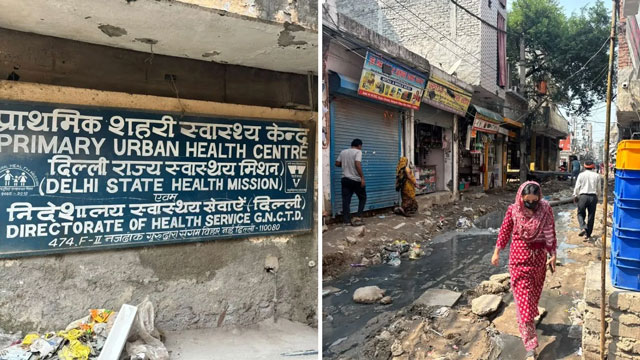
The nearest Ayushman Arogya Mandirs are around seven kilometres away in Saket and Govindpuri.
The situation comes as the BJP government in Delhi expands AyAMs and Primary Health Centres following the phasing out of 553 Mohalla Clinics established under the previous AAP government. According to the 2026 Directorate General of Health Services (DGHS) report, more than 203 such centres are operating across Delhi, but none are located in Sangam Vihar.
Officials have cited the absence of government-owned land as the main obstacle to establishing an AyAM in the locality.
At the PUHC in Gali 10, patients have to descend a staircase to reach a basement facility. Although a banner lists seven rooms, only four are functional.
Santosh, a 46-year-old construction worker who recently arrived from Siwan in Bihar in search of employment, was referred to Nehru Nagar Chest and TB Hospital, around 11 kilometres away, after doctors suspected tuberculosis. The PUHC does not have facilities for TB testing or medicines to treat the disease.
Santosh, who has been staying with his brother-in-law, said he had been suffering from fever, chills, breathlessness and blood in his cough for two weeks.
"I get exhausted. I haven't earned a single penny. What will I send home?" he said.
Staff shortages and multiple responsibilities further affect the functioning of the health centres. A contractual worker at the Gali 10 PUHC said she was hired as a sweeper but also performs nursing and reception duties.
Her day begins at 5 am, after which she travels from Burari by bus and local transport to reach the centre by 8 am. Three other contractual workers are employed at the facility, while a doctor visits only three days a week.
The centre receives around 100 patients daily and provides immunisation, hypertension, diabetes and thyroid care, besides basic blood tests three times a week.
Accessing the PUHC in Gali 15 is another challenge. The road is dug up, sewage pipes remain exposed and black sludge mixes with garbage. Bricks and stones have been placed unevenly to help pedestrians cross.
Ninety-year-old Raja Ram walked nearly a kilometre from Gali 17, leaning on a wooden stick, to seek treatment after developing a fever during the night.
Nutan, a 57-year-old domestic worker earning Rs 12,000 a month, complained of fever, itching and diarrhoea. She attributed her illness to the poor water quality in the area. Her husband is bedridden, leaving her as the family's sole earning member.
She underwent a Widal test and was prescribed antiprotozoal medicines, oral rehydration salts (ORS) and paracetamol.
A health official described Sangam Vihar as a high-risk area because of open drains, accumulated sludge and contaminated water. The official said residents were vulnerable to cholera, diarrhoeal diseases, enteric fever, hepatitis and typhoid, while tuberculosis was also widespread.
The official also pointed to a growing incidence of hypertension and diabetes, including among people in their early twenties.
The DGD in Gali 1 operates from another basement, where four rooms have been divided using makeshift partitions to accommodate a doctor's cabin, pharmacy, immunisation room and TB testing facility.
The premises have an unused, foul-smelling bathroom and a dim waiting area with peeling paint. Elderly patients and women with children wait on steel benches for treatment.
An 85-year-old woman, Anita, was assisted downstairs by Randhir, a nurse who also works as the receptionist. She later left with medicines for fever, cough and a skin condition.
Randhir said women visiting the dispensary were provided with urine pregnancy and haemoglobin testing kits, besides clinical breast examinations. He added that the closure of a Mohalla Clinic in the area had increased the patient load at the dispensary.
The fourth facility, located at Gali F2, shares a building with a charity school and was undergoing repairs during the visit. The centre reportedly receives most of its patients for immunisation.
A DGHS official said government-owned land was mandatory for sanctioning an Ayushman Arogya Mandir. The department has written to the Delhi Development Authority and the Municipal Corporation of Delhi seeking land, but is yet to receive a response.
The official said the available plots near the baraat ghar and on police land were too small to accommodate the facility.
Ayushman Arogya Mandirs serve as the first point of contact for 12 comprehensive healthcare service packages under the National Health Mission.
Sangam Vihar has 22 ASHA workers, each reportedly responsible for a population of 2,000 to 3,000 people. However, staffing at the four existing health facilities remains below the standards prescribed under Indian Public Health Standards.