By Ashwini Dubey
It is well settled that places of worship and pilgrimage cannot be taken by the carrot and the stick. Any illegal encroachment by other faiths doesn't yield any right and equity in favour of the usurper.
The Places of Worship (special provisions) Act, 1991, title read, "An Act to prohibit conversion of any place of worship and to provide for the maintenance of the religious character of any place of worship as it existed on the 15th day of August, 1947, and for matters connected therewith or incidental thereto". This Act is at the centre row over a videographic survey at Gyanvapi mosque, where a "Shiva Lingam" was discovered.
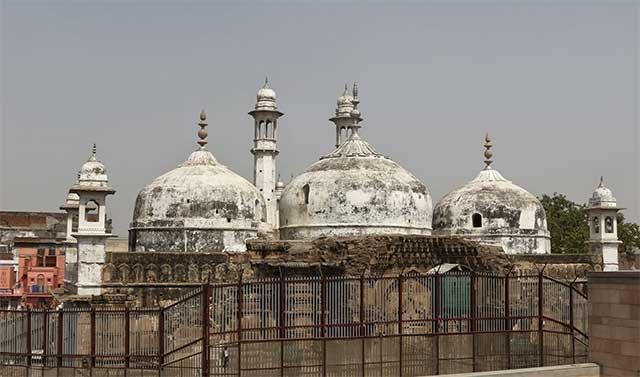
According to Hindu Law, property once vested will continue to be deity's property and likewise, on creation of waqf, the property vests in 'Allah'. The question is whether a waqf can be created over deity property and can such property be assumed to be waqf by user.
Another question is as to whether Hindu Law will be applicable to the properties, which had been encroached upon during invaders' rule or even after Independence, the ghost of slavery will continue to haunt the sentiments of Hindus, Jains, Buddhists, Sikhs and they would consider themselves helpless to remedy the wrong through legal process after enforcement of Constitution.
Hindus, Jains, Buddhists, and Sikhs have right to remedy on the subjects depressed/oppressed during slavery period through legal means. It is also essential to give the message that the power of the pen, not the sword, is mighty and will prevail. As a matter of reference, recently the Taliban demolished Buddha statue on the line of their predecessor invaders, during the Medieval Age.
Invasion and invaders destroyed hundreds of places of worship and pilgrimage to show the might of Islam to realize the Hindus, Jains, Buddhists, and Sikhs that they have been conquered and are being ruled and have to follow dictum of ruler. Hindus, Jains, Sikhs, Buddhists, and the natives of the country were deprived of their right to life, liberty and dignity from 1192 to 1947.
The question is as to whether even after the Independence, they cannot seek judicial remedy to undo the historical wrong through judicial proceedings to establish that law is mightier than sword.
Hindu law prescribes that deity never dies and property once vested in deity shall continue its property and even King cannot take over possession. According to Katyayan (P.V. Kane Vol. III, 327-328):
"Temple property is never lost even if it is enjoyed by strangers for hundreds of years. Even kings cannot deprive temples of their properties.
"Timelessness, thus, abounding in Hindu Deity, there cannot be any question of the Deity losing its rights by lapse of time. Jurisprudentially also, there is no essential impediment in provision, which protects the property rights of minors, like a deity, to remain outside the vicissitudes of human frailties for ensuring permanent sustenance to it, therefore to keep it out of reach of human beings, including King.
"Every law is designed to serve some social purpose; the vesting of rights in Deity, which serve the social purpose indicate above since ancient times, is quite in order to serve social good."
In Ramareddy v. Ranga, the top court held that "managers and even purchasers from them for consideration could never hold endowed properties adversely to deity and there could be no adverse possession leading to acquisition of title in such cases".
The deity which is an embodiment of supreme god and is a juristic person, represents 'infinite- the timeless' and cannot be confined by shackles of time.
Brihadaranakya Upanishad (Mulla's Principles of Hindu Law, page 8) lays down: "Om Purnamadah, purnamidam, purnatpurnamudachyate; purnasayapurnamadaya, purnamevavasisyate (That is Full, this is Full. From the Full does the Full proceed. After the coming of the Full from the Full, the Full alone remains).
In the Mahant Ram Saroop Das Case, the top court recognized that a deity is immortal and it is difficult to visualize that a Hindu private debutter will fail. Even if the idol gets broken, or is lost or is stolen, another image may be consecrated, and it cannot be said that the original object has ceased to exist. In Thakurji Govind Deoji Maharaj Jaipur (1965), the court held: "An idol which a juridical person is not subject to death, because the Hindu concept is that the Idol lives forever".
Thus, The Places of Worship Act, 1991, violates the concept of Hindu law. The deity which is an embodiment of supreme God and is a juristic person, represents the 'infinite- the timeless' cannot be confined by the shackles of time and the Hindu Law recognized the principle that once deity property, will continue to be deity property, and nobody's possession will be valid.
The doctrine of Hindu Law is that "temple property is never lost even if enjoyed by strangers for years and even the king cannot take away property as deity is embodiment of God and is juristic person, represents 'Infinite the timeless' and cannot be confined by the shackles of time."
It's well settled that deity property will continue to be deity property and other's possession will be invalid. This is a serious jolt on the rights of Hindus, Buddhists, Jains, and Sikhs to worship and profess their religion and restore their religious places even through the court. It is necessary to state that members of other faiths have occupied those places taking advantage of the pitiable condition of Hindus during Mughal and British Rule.