Daijiworld Media Network – New Delhi
New Delhi, Dec 17: India may soon join a growing list of countries offering flexible work schedules, including the possibility of a three-day weekend, under the Centre’s proposed new Labour Code. The legislation introduces several important provisions aimed at easing work schedules for employees while clearly defining limits on working hours.
Under the new Labour Code, employees cannot be made to work for more than 48 hours in a week. If this limit is exceeded, employers are legally bound to pay double wages for overtime work. Notably, the code does not prescribe a strict cap on daily working hours.

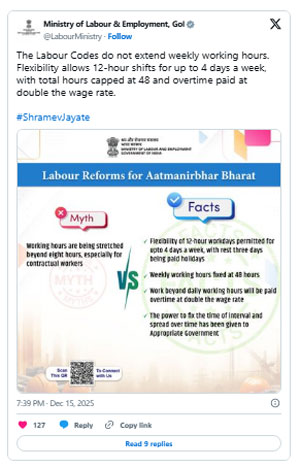
The Ministry of Labour and Employment has clarified that while there is no restriction on the number of hours an employee may work in a single day, the total working time in a week must not cross the 48-hour limit.
Three weekly holidays possible
The new Labour Code allows significant flexibility in structuring work schedules. Employees who work for 12 hours a day over four days will complete the 48-hour weekly limit, making them eligible for three paid weekly holidays. This effectively allows for a three-day weekend.
Employees working eight hours a day will be required to work for six days a week, with just one weekly holiday. Those working for 10 hours a day may be eligible for two weekly holidays. The code enables employees to structure their working hours in line with their weekend requirements, depending on the arrangement agreed upon.
What if the 48-hour limit is crossed?
The Labour Code clearly states that if employers require employees to work beyond 48 hours a week, overtime wages must be paid. The law mandates payment of double the regular wage for any additional hours worked.
Key points to note
The new Labour Code firmly caps weekly working hours at 48, while allowing companies to engage employees for up to 12 hours a day. Whether a company opts for a four-day work week with three weekly holidays, or a six-day work week with a single weekly holiday, will be decided through consultation between employers and employees. Employees cannot independently choose their work schedules.
The government has maintained that the new code seeks to balance workplace flexibility with employee welfare, while ensuring that extended working hours are fairly compensated.