Updated
Daijiworld Media Network - Sriharikota
Sriharikota, Jan 12: India’s first space mission of 2026 suffered a major setback on Monday, January 12 as the Indian Space Research Organisation’s (ISRO) PSLV-C62 failed to reach its intended orbit, with all 16 satellites on board lost due to a third-stage anomaly.
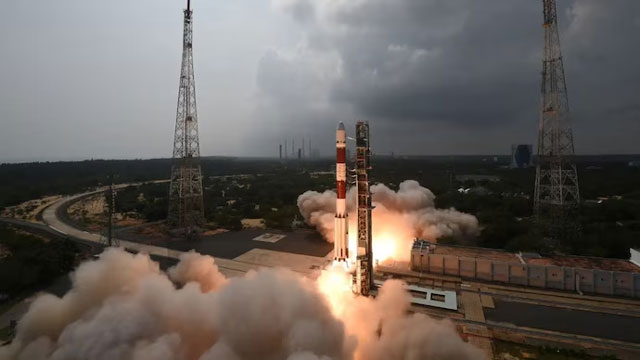
The 44.4-metre-tall PSLV-C62 lifted off from the First Launch Pad at the Satish Dhawan Space Centre, Sriharikota, at 10.17 am, carrying the EOS-N1 earth observation satellite, 14 co-passenger satellites, and a re-entry capsule. The launch, undertaken as a commercial mission for NewSpace India Limited (NSIL), marked the 64th flight of the PSLV.
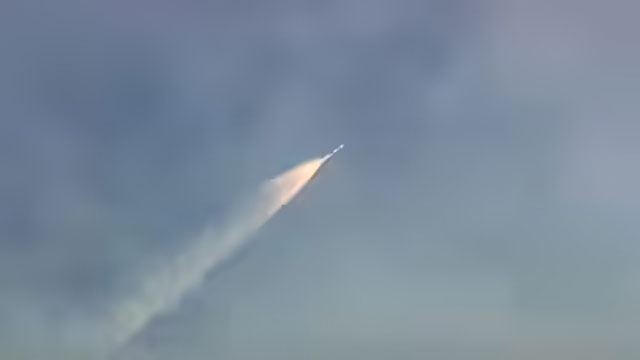
ISRO chairman Dr V Narayanan said the rocket’s first and second stages performed nominally. “Near the end of the third stage, we observed disturbances in the vehicle, followed by a deviation in its flight path. As a result, the mission could not proceed as expected,” he said, adding that detailed analysis is underway.
The mission carried a mix of Indian and international satellites, including payloads from Brazil, Nepal, the UK, and seven satellites from Hyderabad-based startup Dhruva Space. Primary payload EOS-N1 (Anvesha) was designed for hyperspectral earth observation and strategic surveillance. Other notable payloads included India’s first on-orbit satellite refuelling demonstrator AayulSAT and the European KID re-entry capsule from a Spanish startup.
Monday’s failure mirrors PSLV-C61’s setback in May 2025, which also encountered a third-stage anomaly, preventing the EOS-09 satellite from reaching orbit. With this, PSLV has now recorded five failures in 64 missions, slightly denting the reputation of India’s “workhorse” launch vehicle.
The setback has implications for ISRO’s commercial satellite customers, including startups and international clients, and comes at a critical time for India’s growing space industry. A new Failure Analysis Committee has been constituted to investigate the cause and guide corrective measures.
Despite the failure, ISRO reaffirmed its commitment to ensuring reliability in future PSLV missions and continuing India’s push to establish itself as a major global space hub.
Earlier report
ISRO begins 2026 with successful PSLV-C62 mission, EOS-N1 and 14 payloads deployed
Daijiworld Media Network - Sriharikota
Sriharikota, Jan 12: The Indian Space Research Organisation (ISRO) on Monday successfully launched the PSLV-C62 mission, formally kicking off India’s space launch calendar for 2026. The Polar Satellite Launch Vehicle lifted off from the Satish Dhawan Space Centre in Sriharikota, placing the EOS-N1 Earth Observation satellite along with 14 co-passenger payloads into their intended orbits.
According to ISRO officials, EOS-N1 is designed to significantly enhance India’s Earth observation capabilities. The satellite will provide high-resolution data for applications including agriculture monitoring, urban development, infrastructure planning, environmental assessment and disaster management. EOS-N1 is also expected to support near real-time monitoring during natural calamities such as floods, landslides and cyclones.
Among the secondary payloads, Hyderabad-based private satellite MOI-1 has drawn particular attention. ISRO confirmed that MOI-1 has successfully established communication with ground stations and is now fully operational in orbit. The satellite carries the world’s lightest space telescope, marking a technological breakthrough in miniaturised space optics.
In a first-of-its-kind initiative, MOI-1 offers users the ability to rent artificial intelligence computing power directly in space. This allows satellite data—especially related to disasters—to be analysed in orbit itself, rather than waiting for raw data to be transmitted to Earth. Officials said this capability enables faster insights and quicker decision-making during emergencies, potentially saving lives and reducing damage.
Sources said MOI-1’s onboard AI systems can process large volumes of imagery and sensor data in real time, making it especially valuable for disaster response agencies, environmental researchers and government bodies. The satellite is part of India’s growing private space ecosystem, reflecting increased collaboration between ISRO and domestic startups.
ISRO stated that all payloads injected by PSLV-C62 are healthy and performing as expected. Post-launch operations and orbit-raising manoeuvres are underway for EOS-N1 to reach its final operational orbit.
The successful PSLV-C62 mission reinforces ISRO’s reputation for reliability and precision, while also highlighting India’s push towards advanced Earth observation, AI-driven space applications and greater private-sector participation in space missions.