Daijiworld Media Network – New Delhi
New Delhi, Jan 25: The contrasting performances of Sanju Samson and Ishan Kishan in the second T20I against New Zealand have presented India’s selectors with a welcome dilemma ahead of the remaining matches and the T20 World Cup 2026.
When the BCCI announced the 15-member squad for the T20 World Cup in December last year, Samson was named India’s first-choice wicketkeeper, with Kishan as his backup. However, an injury to Tilak Varma, which ruled him out of the first three matches of the five-match T20I series against New Zealand, opened the door for Kishan.
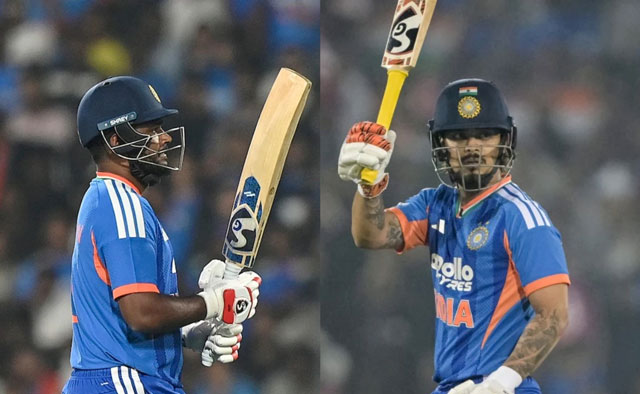
After a quiet outing in the first T20I, batting at No. 3, Kishan made a strong statement in the second match with a blistering 76 off just 32 balls, hitting 11 fours and four sixes. In contrast, Samson struggled to make an impact, managing scores of 10 and six in the two matches so far.
With Tilak Varma likely to return for the remaining two games, either Kishan or Samson could miss out, intensifying the competition for places.
Former India opener and 1983 World Cup winner Krishnamachari Srikkanth said Samson appeared to be under pressure. Speaking on ‘Cheeky Cheeka’, he questioned Samson’s approach, saying the batter looked desperate at the crease.
Srikkanth pointed out that Samson failed to capitalise on a reprieve in the second T20I, getting dropped early in the innings but losing his wicket just two balls later. He said Samson should have focused on rotating the strike and regaining rhythm instead of playing aggressive shots immediately.
“He became desperate, and when you become desperate, you become greedy,” Srikkanth remarked, adding that such mistakes often lead to dismissals.
The former batter further said Kishan’s recent knock has increased pressure on Samson, especially since Kishan is also a wicketkeeper. With intense competition for middle-order spots and several players waiting on the sidelines, Srikkanth felt Samson needed to show patience, much like Suryakumar Yadav, who took time to settle before accelerating.