Daijiworld Media Network - Gaza
Rafah, Feb 3: Even as headlines announced the reopening of the Rafah crossing between Gaza and Egypt, the first day of operations revealed a starkly limited reality, with Israel allowing only five injured Palestinians to leave Gaza for medical treatment on Monday.
The Rafah crossing, Gaza’s only land exit not directly controlled by Israel, had remained closed for nearly two years amid Israel’s ongoing war on the enclave. Its reopening was projected as a key outcome of the second phase of the US-backed Gaza ceasefire agreement. However, the restricted movement on the ground fell far short of expectations and Gaza’s vast humanitarian needs.
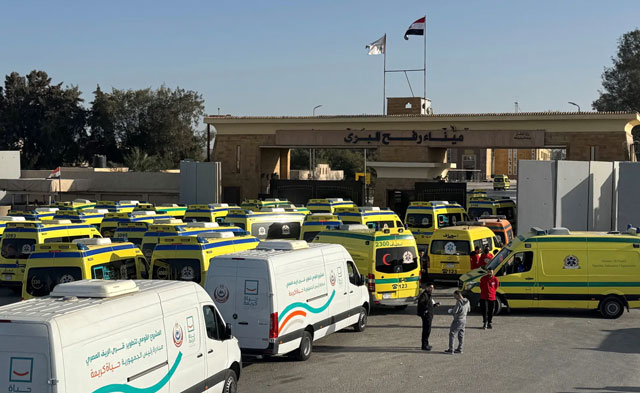
Among the five permitted to cross was 17-year-old Mohammed Abu Mostafa, who travelled with his mother, Randa, from Khan Younis to Rafah. Randa said she received a phone call on Monday morning informing her that her son’s name had appeared on the first list of wounded patients cleared for travel, and that they were instructed to report immediately to the Red Crescent Hospital.
Mohammed suffered a severe eye injury during an Israeli air attack around a year and a half ago in al-Mawasi, Khan Younis, which damaged his optic nerve and significantly impaired his vision. “There is no treatment available for him in Gaza. His condition has only worsened with time,” Randa said.
Under Israeli instructions, each patient was allowed to travel with two companions, bringing the total number of people who crossed to 15, according to Gaza’s health authorities. Mohammad Abu Salmiya, director of al-Shifa Medical Complex, told media that this was the only group permitted to leave, despite earlier coordination with the World Health Organization (WHO) for the daily departure of up to 50 patients.
Officials said the limited numbers highlighted the gap between expectations and reality, with an estimated 22,000 Palestinians in Gaza in urgent need of treatment abroad. At the same time, around 80,000 Palestinians who left Gaza during the war are awaiting permission to return.
Patients and relatives gathered at the Red Crescent Hospital expressed frustration over the strict procedures and restrictions. Several injured people, including amputees, had arrived early in the hope of travelling to Egypt but were denied permission.
According to officials, all travel lists are subject to Israeli security screening, and no one is allowed to cross without explicit approval. The European Union Border Assistance Mission at Rafah is limited to monitoring and identity verification, while additional inspections take place at Israeli-controlled checkpoints.
Raed al-Nims, media head of the Gaza Red Crescent, said authorities were still awaiting updates on the transfer of more patients. He added that some patients were transferred to Israel through the Kerem Abu Salem crossing on Monday in coordination with the WHO.
Another patient allowed to leave, Ibrahim Abu Thuraya, lost his left hand and sustained a serious eye injury earlier in the war. “There are no medical capabilities in Gaza to treat my condition,” he said before travelling. “Thousands of wounded people are waiting like me. I hope the crossing will be opened permanently.”
Despite the symbolic reopening of Rafah, Monday’s events underscored the continuing restrictions and the scale of Gaza’s unresolved humanitarian crisis.