Daijiworld Media Network - Kathmandu
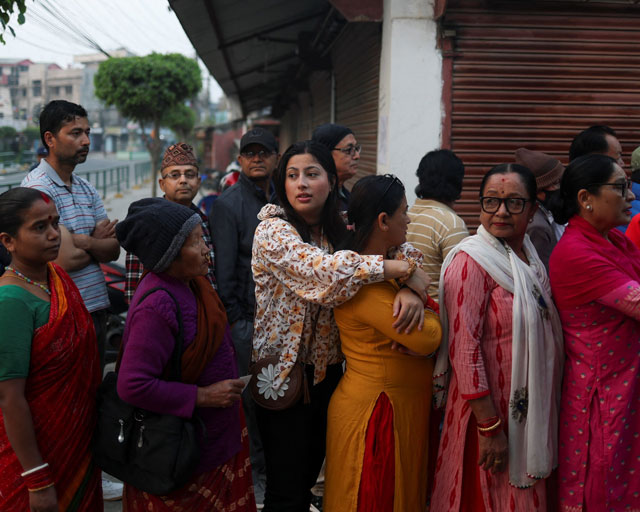
Kathmandu, Mar 5: Nearly six months after a wave of unprecedented youth-led protests forced the then prime minister to step down, Nepal on Wednesday began voting in a crucial general election seen as a decisive contest between entrenched veteran leaders and an energised youth movement.
Around 19 million voters are eligible to cast their ballots to elect a new 275-member House of Representatives, replacing the interim administration formed after the September 2025 uprising that left at least 77 people dead and saw parliament and several government buildings torched.
The protests, largely mobilised under a loose Gen-Z banner, were initially triggered by a brief social media ban but soon snowballed into a broader outcry against corruption, unemployment and Nepal’s struggling economy.
Interim Prime Minister Sushila Karki urged citizens to vote “without any fear” as thousands of police personnel and soldiers were deployed across polling centres to ensure security.
The election has drawn a mix of seasoned politicians and younger aspirants promising sweeping reforms.
Among the prominent faces is former prime minister KP Sharma Oli, 74, the Marxist leader ousted last year, who is seeking a political comeback. He faces a strong challenge in his home constituency of Jhapa-5 from Balendra Shah, the 35-year-old rapper-turned-politician and former Kathmandu mayor representing the Rastriya Swatantra Party (RSP).
Shah has positioned himself as the face of youth-driven political transformation, urging voters to “ring the bell” — his party’s election symbol — to usher in change. The Jhapa-5 seat, with around 163,000 voters, is being closely watched as a symbolic battleground between old and new politics.
Also in the race for the top post is Gagan Thapa, 49, the newly elected head of the country’s oldest political party, Nepali Congress. Thapa has vowed to dismantle what he calls the “old age club” of revolving veteran leaders and bring fresh leadership into governance.
Helicopters have ferried voting materials to remote, snowbound mountain districts, home to eight of the world’s 10 highest peaks, including Mount Everest.
However, much of the political spotlight remains on the fertile plains south of Kathmandu, where all three prime ministerial hopefuls are contesting seats — a notable shift from earlier elections centred around the capital.
More than 3,400 candidates are vying for 165 seats under the direct election system, while 110 additional members will be selected through proportional representation.
Chief Election Commissioner Ram Prasad Bhandari said ballot boxes from remote areas would also be transported by helicopter after polling concludes. Results under the direct election system are expected within 24 hours of counting, though proportional representation outcomes may take longer.
Analysts predict that no single party is likely to secure an outright majority, raising the prospect of protracted coalition negotiations in the days following the vote.
Voting is scheduled to close at 5 pm. For many citizens, the election represents more than a routine democratic exercise.
“This is not a normal election. It could be a turning point for Nepal,” said a voter in Kathmandu, echoing widespread hopes that the upheaval of last year will translate into lasting political change.