Daijiworld Media Network - Cairo
Cairo, Jul 20: The ongoing military confrontation between the United States and Iran widened across the Middle East on Sunday, with Jordan, Kuwait and Bahrain reporting fresh Iranian missile and drone attacks, triggering renewed regional concerns and urgent calls for restraint.
Jordan said its air defence systems intercepted three missiles fired from Iran towards its territory, while a fourth missile landed in an isolated area in the country's south without causing casualties or damage. According to media reports, the missiles were reportedly aimed at US military aircraft stationed in Aqaba, Jordan's southern coastal city bordering Israel's Eilat.
Following the missile launches, reports indicated that the US military relocated refuelling aircraft from Ramon Airport in southern Israel as a precaution. Commercial flight operations at the airport also experienced delays after the incident.
Earlier in the day, the US Embassy in Amman issued a security advisory warning of a "specific and credible threat" and announced the temporary evacuation of Aqaba's airport and seaport, urging American citizens to stay away from the facilities. Jordanian authorities, however, rejected the claim, stating that both the airport and seaport continued to function normally.
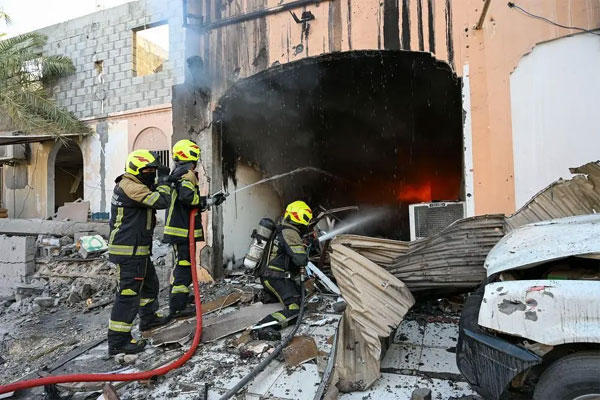
Kuwait also reported multiple aerial threats, with its armed forces confirming that air defence systems intercepted hostile ballistic missiles and drones over the country. Officials said another attack targeted a power generation and water desalination facility, sparking fires and causing significant infrastructure damage.
In a statement, the Kuwaiti military said it had been tracking and engaging incoming missiles and drones since early morning, though it did not disclose the exact number intercepted. It accused Iran of striking civilian infrastructure, including facilities managed by the Ministry of Electricity, Water and Renewable Energy.
Bahrain similarly announced that its air defence systems had intercepted several Iranian aerial attacks, although authorities did not provide further operational details.
The latest wave of attacks has intensified fears of a broader regional conflict, prompting renewed diplomatic efforts to contain the crisis.
Arab League Secretary-General Nabil Fahmy warned that the escalating military exchanges could have severe consequences for the region and appealed to both Washington and Tehran to immediately reduce tensions. He cautioned that continued hostilities risked spiralling into a wider conflict, causing further human suffering and deepening economic instability across the Middle East.
Jordan's Deputy Prime Minister and Foreign Minister Ayman Safadi held separate discussions with Turkish Foreign Minister Hakan Fidan and Kuwaiti Foreign Minister Sheikh Jarrah Jaber Al-Ahmad Al-Sabah to coordinate efforts aimed at restoring regional stability.
During his conversation with the Turkish foreign minister, Safadi emphasised the importance of halting the escalation, implementing the existing US-Iran ceasefire agreement and resuming diplomatic negotiations to address the underlying causes of the conflict.
In his talks with Kuwait's foreign minister, Safadi reaffirmed Jordan's solidarity with Kuwait and other Gulf Cooperation Council (GCC) member states facing Iranian attacks. Both leaders agreed that dialogue and diplomacy remained the only viable path to ending the crisis and ensuring lasting peace and security in the region.
The developments come amid rapidly escalating tensions between the United States and Iran. According to reports, the United States has carried out eight rounds of strikes against Iranian targets, while Iran has retaliated by attacking US military bases and facilities across several countries in the region, raising fears that the conflict could expand further.