Daijiworld Media Network – New Delhi
New Delhi, Aug 20: The Supreme Court has issued nationwide directions for the strict implementation of the Solid Waste Management (SWM) Rules, 2026, expressing concern over the growing volume of waste and poor civic responsibility towards its segregation, management and disposal.
A bench comprising Justices SVN Bhatti and NV Anjaria directed authorities to conduct a comprehensive audit of existing solid waste management infrastructure and upgrade it to meet the standards prescribed under the new rules.
The court observed that society appeared to have adopted an attitude of generating waste without taking responsibility for its consequences. It noted that the growing volume and complexity of waste — including biodegradable, non-biodegradable, hazardous, electronic and construction waste — could no longer be handled solely by sanitation workers.
The bench was hearing appeals arising from National Green Tribunal proceedings concerning municipal corporations' compliance with solid waste management regulations. The matter initially involved the Bhopal Municipal Corporation but was subsequently expanded nationwide considering the scale of the problem.
The court expressed concern over poor compliance among individuals and institutions, including schools, colleges, commercial establishments, professionals and households.
The Supreme Court also took note of the Centre's establishment of statutory committees for implementing and enforcing the SWM Rules, which came into force on April 1. However, it stressed that committees and enforcement agencies alone would not be sufficient to address the persistent hazards caused by non-compliance.
The court directed district collectors across the country to identify all bulk waste generators (BWGs) within their jurisdictions, in coordination with local bodies, within six weeks.
It also directed the Union Environment Ministry to confer special powers on district collectors under the Environment (Protection) Act, 1986, enabling them to take punitive action against violators.
Through the chief secretaries of the states, authorities have been directed to inform bulk waste generators about the consequences of violating the SWM Rules. These measures may include temporary disconnection of electricity or water supply until the waste generated is brought into compliance with the rules.
The court further ordered the creation of a special cell in every district, including regional officers of pollution control boards. The cells will have the authority to direct disconnection of electricity and water supplies of bulk waste generators that fail to properly segregate and process their waste.
Bulk waste generators include establishments producing more than 100 kg of waste per day, those with a built-up area exceeding 20,000 square metres, or those consuming more than 40,000 litres of water a day. Large hotels, malls, hospitals, commercial complexes and residential societies fall within this category.
The court directed such establishments to install the required waste-processing facilities and submit compliance reports online to local bodies for inspection. The reports will subsequently be forwarded to district collectors.
The Supreme Court emphasised that every individual, household and institution generates solid waste as part of daily life and activity. It rejected the notion that waste management is solely the responsibility of sanitation workers.
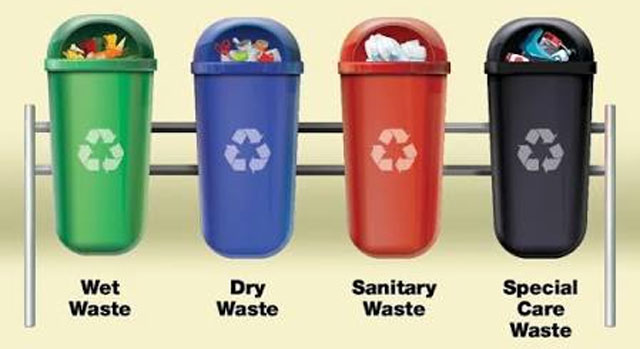
Under the new rules, waste is required to be segregated at source into four categories — wet waste, dry waste, sanitary waste, and special-care or domestic hazardous waste.
The bench observed that while legislation can prescribe obligations and penalties, genuine compliance requires individuals and institutions to recognise and internalise their responsibility.
The court identified the unorganised sector comprising residential, commercial and business establishments as a major challenge in ensuring effective implementation of the waste management rules.
It stressed that proper waste management requires not only stronger infrastructure and enforcement but also a fundamental change in civic behaviour and public responsibility.