Daijiworld Media Network - Jammu
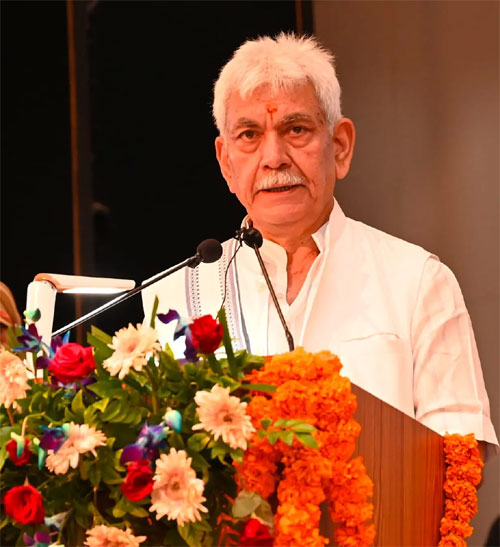
Jammu, Aug 21: Jammu and Kashmir lieutenant governor Manoj Sinha on Friday urged the youth to develop region-specific solutions instead of simply replicating foreign models, saying agriculture and allied sectors represent the next major frontier of global innovation.
Sinha inaugurated a series of new infrastructure facilities at the Sher-e-Kashmir University of Agricultural Sciences and Technology (SKUAST), Jammu, and addressed the launch of the Startup Outreach Programme under JKCIP. The event brought together researchers, innovators, young entrepreneurs and farmers from across the Jammu division.
The newly inaugurated facilities include the Unnati Girls Hostel, Centre for AI and ML in Agriculture, Centre for Mushroom Research and Innovation, Advanced Sericulture Laboratory and Centre for Digital Media and Publication.
Speaking on the occasion, Sinha described the facilities as more than physical infrastructure, calling them a commitment to the region’s innovators, entrepreneurs, researchers and farming families.
He cited technology-driven agriculture initiatives in countries such as the Netherlands, Israel, New Zealand and Brazil, highlighting innovations ranging from AI-based animal nutrition and health solutions to data-driven farming, digital animal husbandry and smart irrigation.
The Lieutenant Governor said these examples demonstrate that agriculture and allied sectors are emerging as a major frontier for innovation worldwide.
At the same time, he cautioned Jammu and Kashmir’s youth against blindly adopting overseas models and encouraged them to understand their own fields, farmers, climate and local challenges before developing solutions.
“Today, there are startups worldwide continuously exploring new possibilities in agriculture and allied sectors. The biggest message from these startups and innovations is that agriculture and allied sectors themselves are the next big frontier for innovation. You must understand your own fields, farmers, climate, and local problems to prepare your next solution, and customise those models in your own way wherever appropriate,” he said.
“I believe that different countries have innovated for their own problems, and now it is time for Jammu and Kashmir to innovate for its own questions and challenges,” Sinha added.
He also highlighted changing employment aspirations among India’s youth, saying young people in Jammu and Kashmir are increasingly seeking to create jobs rather than wait for employment opportunities.
Calling entrepreneurship central to the vision of a self-reliant Jammu and Kashmir, Sinha told students that their degrees should be viewed as a starting point for innovation rather than an end in themselves.
“Your degree is not your destination; rather, it is like a runway for your flight of success. SKUAST-Jammu will give you knowledge, but your curiosity will give you new thoughts and ideas. Your courage will turn that idea into a startup,” he said.
He added that sustained patience, honesty and hard work could eventually transform startups into sources of employment and dignity for others.
“That is why I often say that the truest meaning of a Self-Reliant Jammu and Kashmir is a region where every young citizen becomes an employer in some form, according to their ability and talent,” Sinha said.
The Lieutenant Governor also called for diversification beyond traditional farming, encouraging young and progressive farmers to explore cold chains, grading and packaging facilities, regional branding and digital marketplaces that could connect Jammu and Kashmir’s produce with markets in Delhi, Dubai and beyond.
He identified greater participation of women as a key priority for the entrepreneurship ecosystem.
“No entrepreneurship revolution can be complete without the equal and active participation of women. And no economy can truly become strong until women are equal partners in it. I do not just want to see women present in enterprises; I want to see enterprises led by women,” Sinha said.
He urged stakeholders to ensure that women-led Self-Help Groups and Farmer Producer Organisations receive equal access to finance, technology and markets, and encouraged research and innovation that supports women entrepreneurs and creates employment opportunities for others.
On the Startup Outreach Programme, Sinha said its focus was on reaching farmers and young people in villages who may not have previously been exposed to incubation, mentoring or venture capital.
He said some of the most useful solutions to agricultural problems are often developed by people who have experienced those problems themselves.
According to Sinha, SKUAST-Jammu has so far selected more than 150 students for idea incubation and supported 56 promising startups, while expanding its outreach to remote parts of the Jammu region.
Calling the progress a commendable beginning, he urged the university to scale up these efforts and become a stronger bridge between laboratories and markets, scientists and farmers, and technology and ground-level needs.
“Real success of SKUAST-Jammu will not be measured only by how many students graduate from here, but the success of this campus will be measured by how many new ideas were born here, how many solutions to problems were developed here, how many enterprises were established here, and how many farming families’ lives were positively changed by those enterprises,” he said.
Sinha urged students to ask themselves four questions every day: what problem can they solve, what enterprise can they build, what value can they add to agriculture, and how many families can benefit from their idea.
“If these four questions keep troubling your mind continuously, then no one can stop you from finding the purpose of your career,” he said.
He expressed confidence that Jammu and Kashmir would increasingly be recognised for innovation, agricultural entrepreneurship, science, technology and youth leadership.
“Do not make your dreams small. Do not let your circumstances become the limits of your future. Draw strength from your roots, direction from knowledge, speed from technology, and create new paths with your resolve,” Sinha said.
He also felicitated eight startups, FPOs and cooperative/rural enterprises for their contributions to agriculture, allied sectors, value addition and rural enterprise development.
Four publications were released on the occasion: “Policy Document for Promoting Medicinal and Aromatic Plants in J&K”, “Chronicle of Innovation & Startups under RKVY-RAFTAAR, SKUAST-Jammu”, “Value on the Vine: Economic and Market Dynamics of Vegetables” and “Student’s Rural Exploration Programme (SREP)”.
Shailendra Kumar, Additional Chief Secretary, Finance Department; Prof B.N. Tripathi, Vice Chancellor, SKUAST-Jammu; Dr Amrish Vaid, Director Extension; Dr Anil Kumar, Registrar; faculty members, senior officials, students, scientists, entrepreneurs and representatives of startups, FPOs and cooperatives attended the programme.