Daijiworld Media Network - Washington
Washington, Aug 30: NASA is set to launch its next-generation Nancy Grace Roman Space Telescope on Sunday, a major observatory expected to survey hundreds of millions of stars and billions of galaxies while helping scientists investigate some of the biggest mysteries of the universe.
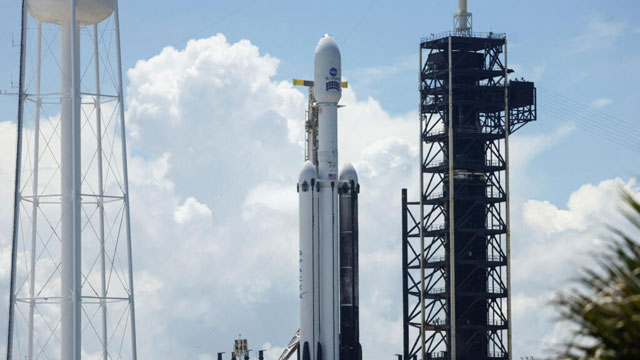
The telescope is scheduled to lift off at 7.26 am ET from NASA’s Kennedy Space Center in Florida aboard a SpaceX Falcon Heavy rocket. NASA is scheduled to begin live coverage of the launch at 6.20 am ET.
Often compared with the Hubble Space Telescope, the Roman observatory is designed to survey a much larger portion of the sky and provide scientists with an unprecedented panoramic view of the cosmos.
During its planned five-year mission, Roman is expected to study vast regions of the Milky Way, identify more than 100,000 planets around other stars and collect data that could provide fresh insights into dark matter and dark energy.
Astrophysicist Neil deGrasse Tyson, director of the Rose Center for Earth and Space at the American Museum of Natural History in New York, said the nature of dark matter and dark energy remains among the biggest unanswered questions in modern astrophysics.
Scientists believe dark matter makes up most of the matter in galaxies, although it cannot be observed directly and is instead detected through its gravitational effects. Dark energy, meanwhile, is the unexplained phenomenon believed to be responsible for the accelerating expansion of the universe.
Roman is expected to survey the sky about 1,000 times faster than Hubble, while each of its images will cover a region of sky at least 100 times larger than a Hubble image.
The $4.3-billion mission has been under development for nearly two decades and is now expected to launch about nine months earlier than previously planned. NASA teams had to overcome challenges including the Covid-19 pandemic and government shutdowns in the United States.
Following launch, Roman will spend more than three months travelling to its destination roughly one million miles from Earth. It will operate near the second Sun-Earth Lagrange point, or L2, where the gravitational forces of the Sun and Earth allow spacecraft to maintain a stable position relative to the Earth.
Roman will join NASA’s James Webb Space Telescope, which has also been operating near L2 since its launch in 2021.
The mission will conduct three major surveys. The largest, lasting more than a year, will examine the densely populated central region of the Milky Way, known as the galactic bulge, creating a vast catalogue of stars and other astronomical objects.
The other two major surveys will focus on dark matter and dark energy. By mapping the distribution of matter and observing how the universe has evolved, scientists hope Roman will help refine their understanding of the forces shaping the cosmos.
The telescope is named after Nancy Grace Roman, NASA’s first chief of astronomy, who played a crucial role in establishing the agency’s space-based astronomy programme.
Roman, born in 1925 and who died in 2018, was instrumental in securing congressional support for the Hubble Space Telescope and was later widely known as the “mother of the Hubble Space Telescope”.
NASA named its newest space telescope after Roman in 2020, recognising her contribution to modern space astronomy.
Space-based observatories such as Roman can observe the universe more clearly than many ground-based telescopes because Earth’s atmosphere absorbs certain wavelengths of light and can distort observations.
With its wide field of view, rapid surveying capability and focus on dark matter, dark energy and exoplanets, the Roman Space Telescope is expected to significantly expand humanity’s understanding of the universe and provide scientists with data that could help answer some of astronomy’s most enduring questions.