Daijiworld Media Network - Washington
Washington, Aug 31: An increasing number of mail-in ballots are being rejected for arriving after election deadlines in several US states, raising concerns among election officials about whether the US Postal Service (USPS) can reliably deliver ballots during the 2026 midterm elections.
An analysis of election data from 12 states — California, Colorado, Maine, Maryland, Michigan, Nebraska, New Jersey, Pennsylvania, Utah, Virginia, Wisconsin and Washington — found that late-arriving ballots accounted for a growing share of rejected mail votes in recent primaries and elections.
The trend is particularly evident in battleground states where closely contested races could determine control of Congress, as well as in key gubernatorial and statewide contests.
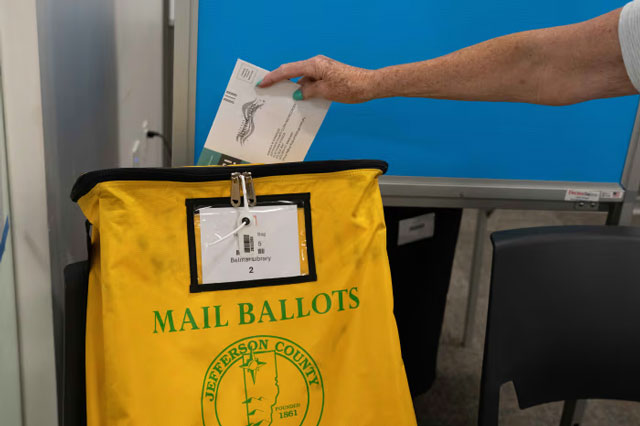
In Wisconsin, about 5,000 mail ballots were rejected for arriving late during this year's spring primary, accounting for 78% of all rejected mail ballots. During the 2023 spring election, about 2,300 ballots, or 47% of rejected ballots, were discarded because they arrived late.
Michigan recorded more than 10,000 mail ballots rejected for arriving after the 8 p.m. Election Day deadline in its primary earlier this month, nearly twice the number rejected in 2024. In Washington, late-arriving rejected ballots rose from about 16,000 to more than 20,000 over the same period.
The increase comes amid significant changes and financial difficulties at the USPS. The agency has faced a multibillion-dollar deficit and has introduced cost-cutting and restructuring measures that election officials say have contributed to slower mail delivery.
Following the 2020 presidential election, the USPS introduced special procedures to prioritise timely delivery of election mail. However, subsequent structural changes have affected overall delivery speeds.
As part of its 10-year financial plan launched in 2021, the Postal Service established regional distribution centres and changed its delivery standards for first-class mail from three days to five days.
Another major change came in 2024, when the USPS introduced a centralised system for postmarking mail at regional processing centres rather than when it first enters the postal system. Election officials say this has created additional concerns in states where postmarks are used to determine whether ballots are valid.
The issue has become politically sensitive as President Donald Trump and his allies seek changes to the country's mail-voting system. Around two dozen states challenged an executive order concerning mail voting, which sought to require states to provide voter information and give the Postal Service authority to restrict the mailing or delivery of ballots in states that did not comply.
A federal judge on Thursday blocked the Postal Service from implementing the plan, finding that it appeared to exceed the agency's legal authority and could cause disruption by changing election-related rules less than 70 days before an election. The administration has appealed the ruling.
Election officials are now introducing measures to reduce the risk of ballots being rejected because of postal delays.
In Colorado, officials have significantly increased the number of ballot drop boxes and are sending ballots earlier. Secretary of State Jena Griswold said the changes were a direct response to uncertainty surrounding postal services and political efforts to alter election procedures.
The USPS has defended its performance, saying more than 95% of mail ballots have arrived on time in recent elections. The agency has urged voters who choose to vote by mail to send their ballots as early as possible.
The Postal Service had agreed after a 2021 court case to maintain procedures designed to ensure timely delivery of election mail during even-numbered federal elections through 2028.
William Hensley, a former Postal Service election-mail specialist involved in developing those procedures, said the higher number of delays during primary and odd-year elections could indicate that the special measures were effective during federal election years. However, he acknowledged that broader structural changes affecting postal deliveries were also having an impact on ballots.
Local election officials have reported increasingly unusual delays. In Wisconsin's April state Supreme Court election, several hundred ballots arrived a day late in Dane County, which includes Madison. County Clerk Scott McDonell said such a situation was highly unusual compared with previous elections.
A Wisconsin Elections Commission survey found that about two-thirds of county clerks had observed problems with mail delivery times during that election.
In Washington, where elections are conducted almost entirely by mail, Elections Director Stuart Holmes said voters were increasingly turning to ballot drop boxes rather than relying on the Postal Service.
Utah election official Ricky Hatch said election authorities across the country had gradually shifted their advice from simply asking voters to meet the deadline to urging them to mail ballots at least a week early.
“Better yet, use a drop box,” he said.
Although late-arriving ballots still represent only a small portion of total mail votes — with the USPS generally delivering more than 95% of election mail on time — election officials fear that even relatively small increases could become significant in closely fought 2026 midterm races.