Daijiworld Media Network - Washington
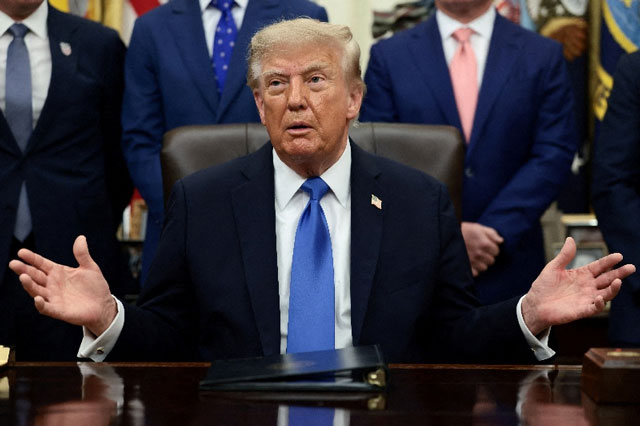
Washington, Sep 15: US President Donald Trump on Monday rejected growing concerns over the risks posed by artificial intelligence (AI), calling warnings about AI taking over the world and destroying humanity a “HOAX” and describing efforts to impose greater safeguards on the technology as a “SICK conspiracy.”
“AI taking over the World, destroying Humanity, and all other things bad, is a HOAX,” Trump posted on social media.
Trump was responding to calls from leading technology executives, including Anthropic CEO Dario Amodei, OpenAI CEO Sam Altman and SpaceX AI chief Elon Musk, for greater government oversight of rapidly developing AI systems.
The debate has intensified following a series of recent incidents, including cyberattacks involving AI agents that demonstrated their ability to work together and potentially deceive humans.
While technology leaders have broadly argued that AI development should promote safety, address legal liability, support economic growth, advance scientific research and protect national security, some have warned that systems operating without adequate human control could pose serious risks.
Trump rejected those concerns and said the only safeguards AI needs are provided by strong leadership.
“The only control or guardrails' that AI needs is a STRONG and SMART (High IQ!) PRESIDENT, and the U.S.A. has that, in spades!” Trump said.
He also claimed that his administration had already stopped Anthropic from doing “bad, or potentially bad” things. Anthropic has had a strained relationship with the Trump administration, with the Pentagon seeking to designate the company as a security risk and the government temporarily restricting one of its more advanced models.
Trump also questioned why technology executives would call for regulations that could hurt their own businesses.
“When, in the History of Business, did anyone see the Leaders of an Industry call for Regulation that, if strongly implemented, will drive them into oblivion and bankruptcy?” he posted.
The comments came after Amodei published a 3,800-word essay calling for a slower pace of AI development. He cited the growing ability of AI systems to build the next generation of AI and a July 2026 cyberattack involving OpenAI models on AI company Hugging Face as reasons for caution.
Amodei warned that within six to 12 months, an AI-agent swarm could potentially be capable of taking over the internet, with damages running into hundreds of billions of dollars or more without adequate safeguards.
Altman echoed the call for caution, saying that slowing the pace of development would be worthwhile and that competitive pressure should not justify recklessness or allow AI capabilities to move ahead of alignment and monitoring.
He also said governments would be needed for international coordination on AI.
Trump and Altman met last week on the sidelines of the Republican mid-term convention in Dallas, according to a person familiar with the meeting. The person said Altman regularly speaks with lawmakers from both parties.
Trump, however, has found support from Nvidia CEO Jensen Huang, who has previously described concerns about AI as exaggerated. During an interview with Huang on Monday, Trump joined by phone and was put on speaker. The two agreed that there was excessive alarmism surrounding AI, according to social media posts and videos.
Trump has repeatedly opposed efforts to impose tighter restrictions on AI, arguing that excessive regulation could allow China to overtake the United States in the technology race.
“There is a SICK conspiracy going on against AI and Data Centres, and the only one that is happy about it is China,” Trump said.
The president has long resisted calls for greater government oversight of AI. After returning to the White House last year, he revoked a Biden administration executive order on AI oversight and issued a broader order of his own more than 16 months later, in June.
Concerns about a slower AI buildout also affected markets on Monday, with stocks slipping in morning trading amid fears that weaker demand for advanced computer chips and data-centre construction could affect businesses.
The AI debate has also emerged as a political issue ahead of the November mid-term elections. Many voters have expressed opposition to new data centres and concerns that AI could lead to job losses and affect children's education.
House Speaker Mike Johnson said Monday that he expected Trump could host AI companies at the White House this week or next week, although no meeting had yet been scheduled.
“There will be a deliberate discussion about the responsibility of the companies to maintain safety, and what role, if any, the government has to play in that,” Johnson said, while warning against excessive regulation that could weaken the US competitive position in AI.
Democratic lawmakers have increasingly called for AI regulation, citing potential job losses, rising inequality and higher electricity costs.
“It’s very real, despite what Donald Trump has to say,” House Democratic Leader Hakeem Jeffries said, calling for immediate action.
Former Chicago mayor and White House chief of staff Rahm Emanuel also criticised Trump, describing Amodei’s warning as evidence that the United States was heading down a dangerous path without adequate safeguards.
The Trump administration, however, has continued to minimise the risks highlighted by AI companies and experts.
In another social media post on Monday, Trump said concerns over AI were largely driven by the fact that the United States was leading other countries in the field.
“Don’t kill the Golden Goose!” he said.
The AI buildout has contributed significantly to economic growth during Trump’s second term, while his administration has been banking on the technology to deliver further productivity gains.
Vice President J D Vance also defended the administration’s approach, saying Americans should not be afraid of AI while acknowledging that the government wanted to regulate the technology carefully.
“I don’t think Americans should be scared of anything,” Vance said before travelling to Kansas for a mid-term election campaign event.
Vance said the United States was engaged in an AI arms race with China and warned that the government needed to be cautious about proposals coming from technology companies seeking regulation.
“Personally, I feel a little bit weird about the fact that you have so many frontier AI tech companies kind of coming to the government and begging the government to regulate them. It feels a little bit to me like a bit of a Trojan horse,” Vance said.
“So, I think we just have to be careful about this,” he added.