Daijiworld Media Network - New Delhi
New Delhi, Oct 14: External Affairs Minister S Jaishankar has expressed optimism about progress in India’s trade negotiations with the United States and efforts to normalise ties with China, while defending New Delhi’s longstanding relationship with Russia and calling for safeguards to regulate artificial intelligence (AI).
In a wide-ranging interview with Bloomberg Editor-in-Chief John Micklethwait on Tuesday, Jaishankar outlined India’s approach to its major international partnerships, saying the changing global order required countries to reassess their relationships with Washington while protecting their strategic interests.
On ties with the US, Jaishankar said Washington had changed the way it engaged with the world, requiring every country to reconsider its relationship with the United States.
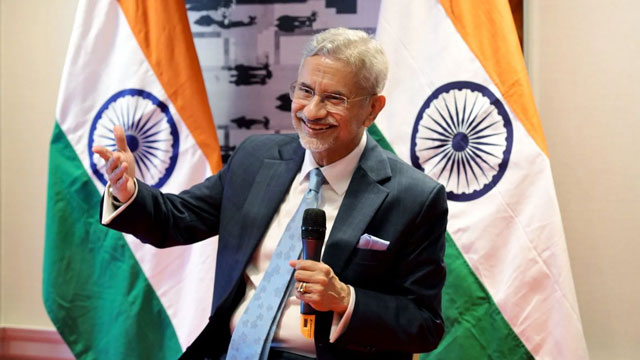
“The reality is, the United States has repositioned itself. It’s changed the manner in which it engages the world, the basis on which it engages the world. So I think every country, in a way, has to recalculate and reset its relationship with the United States,” he said.
He emphasised that India’s relationship with Washington was a strategic partnership rather than a formal alliance.
“We are a country which has a strong strategic partnership with the US. But a strategic partnership is a partnership. It’s not an alliance,” he said.
On the proposed India-US trade deal, Jaishankar said negotiations were progressing in the right direction, with officials from both countries working to resolve outstanding issues.
He said the trade representatives and India’s Commerce and Industry Minister were working through the remaining differences and expressed confidence that an agreement was approaching a conclusion.
“We’re very encouraged by it,” he said, adding that the two sides needed to resolve the remaining issues to reach an agreement.
China relations and border dispute
On relations with China, Jaishankar said both countries were exploring ways to make incremental progress on their longstanding boundary dispute, stressing that maintaining peace and stability along the border was essential for broader ties.
He said the situation in the border areas had improved considerably since 2024 and that bilateral relations were gradually moving towards normalcy.
“If you want a normal relationship, if the rest of the relationship is to move, then it makes common sense. It’s a no-brainer that the boundary has to be stable,” he said.
Jaishankar clarified that India was not insisting on a complete resolution of the boundary dispute before conducting business with China. Instead, New Delhi expected peace and tranquillity to be maintained along the border.
However, he said India continued to face economic challenges in its dealings with China, particularly over market access and fair competition.
“We do believe today that we are not getting a level playing field in China, in the manner in which we have given a level playing field to them,” he said.
Regarding the boundary dispute, Jaishankar said the two sides were discussing an “early harvest” approach, under which certain portions of the border could be settled first, leaving more complicated sections for subsequent negotiations.
He said various proposals had been exchanged and discussions were continuing, although the outcome remained uncertain.
Jaishankar also stressed that progress on the boundary issue would not automatically translate into changes in India’s economic policies towards China. Matters relating to trade, market access and investment would be handled separately from the border negotiations.
India defends ties with Russia
Jaishankar defended India’s relationship with Russia, arguing that Moscow should have multiple strategic and economic partners rather than becoming increasingly dependent on China.
He acknowledged that the war in Ukraine had pushed Russia towards Asia, with China becoming a major focus of its engagement in the region.
“The result of what has happened because of the Ukraine war is that Russia perforce has turned much more to Asia, and in Asia, obviously much of that is towards China,” he said.
Jaishankar argued that India remained a natural partner for Russia, given the relationship built over several decades.
He said New Delhi was reassuring Moscow that its longstanding partnership with India remained stable and continued to serve the interests of both countries.
Jaishankar added that it was in the interests of both Russia and the wider international community for Moscow to maintain significant relationships with countries across Europe and Asia.
India-EU trade agreement
On trade relations with Europe, Jaishankar expressed hope that the proposed India-European Union free trade agreement (FTA) could enter into force in the coming months, potentially by the end of the year or early next year.
He also welcomed Europe’s growing emphasis on strategic autonomy, saying the approach aligned with India’s preference for independent decision-making in international affairs.
The proposed agreement is expected to strengthen economic engagement between India and European countries, although its implementation will depend on the completion of the necessary negotiations and procedures.
Calls for AI safeguards
Turning to artificial intelligence, Jaishankar described AI as one of the most consequential technologies, warning that its growing influence would affect everyday life on an unprecedented scale.
“AI is, in that sense, mother of all technologies that we know so far,” he said.
He stressed that the technology would have far-reaching implications and that people across society would have a stake in how it was developed and deployed.
Jaishankar said there was broad agreement on the need for regulation and safeguards to ensure that AI was developed and used responsibly.
“I think there’s a pretty good consensus on this, that yes, there should be regulation, there should be guardrails,” he said.
He also called for making AI more accessible and available for everyday use, emphasising that its benefits should reach ordinary people rather than remain under the control of entities over which they had little influence.
His remarks highlighted India's efforts to balance technological advancement with public accessibility and appropriate safeguards as AI becomes increasingly influential across sectors.