Most people never plan to be the one who steps in during an emergency. Then a coworker collapses, a child starts choking at a family dinner, or someone slips on an icy sidewalk, and suddenly every second counts. If you have been thinking about getting trained, pursuing First Aid Certification Toronto is one of the most useful decisions you can make this year. For readers living in or moving to Toronto, the process is simpler and faster than most people expect, and this guide walks you through it step by step.
Why Does First Aid Training Actually Matter?
Here is a number worth sitting with. In Canada, roughly 60,000 cardiac arrests happen outside of a hospital every year, and only about 1 in 10 people survive. That survival rate is not fixed. When a bystander starts CPR and an AED is used quickly, survival can double.
The hard truth is that ambulances take time. In a busy city like Toronto, traffic, elevators, and long hallways all add minutes. Those minutes belong to whoever is standing closest to the person in trouble. Training turns a frightened bystander into someone who knows what to do with their hands and their voice.
First aid is not only about cardiac arrest, either. It covers bleeding you need to control, burns, allergic reactions, broken bones, and the everyday scrapes that come with raising kids or running a workplace. The skills carry over into almost every part of life.
Who Should Get Certified?
The short answer? Almost anyone. But some people have a clearer reason than others.
- Parents and caregivers, who want to feel ready if a child chokes or has a bad fall.
- Teachers, coaches, and camp staff, who are responsible for groups of kids.
- Workers in trades, warehouses, kitchens, and salons, where cuts and burns are part of the job.
- Healthcare and personal-support students, who often need a current certificate before a placement.
- Newcomers settling into the city, who want a recognized Canadian credential on their resume.
In Ontario, many workplaces also fall under safety rules. Under the province's Occupational Health and Safety Act and WSIB Regulation 1101, employers must have trained first aiders on site. On a smaller shift of five or fewer workers, one person needs Basic First Aid. On a larger shift of six or more, one person needs Intermediate First Aid. If you are job hunting, holding a WSIB-compliant certificate can genuinely set you apart.
What Are the Main Course Levels?
It helps to know the menu before you book. Most people choose from a handful of options.
CPR/AED Level C teaches cardiopulmonary resuscitation for adults, children, and infants, plus how to use an automated external defibrillator. It is a strong starting point if your main goal is being ready for a cardiac emergency.
Basic First Aid is a shorter course covering the essentials: assessing a scene, calling for help, controlling bleeding, and handling common injuries. It usually includes CPR.
Intermediate First Aid is the fuller option. It goes deeper into injuries, medical emergencies, and longer scenarios, and it is the level many employers ask for. In June 2026, a national standard update renamed the older course titles, so what some people still call Standard First Aid is now Intermediate First Aid. The content and the thresholds did not change.
BLS, or Basic Life Support, is built for healthcare providers and students heading into clinical roles. It moves faster and assumes you will use these skills on the job.
There is also Marine First Aid for people who work on or near the water, which matters in a port and lakefront city.
How Does Blended Learning Work?
This is the part that surprises people. You do not have to spend two full days in a classroom anymore.
Blended learning splits the course into two pieces. First, you complete the theory online, at your own pace, from your couch or your kitchen table. You read, watch short videos, and answer questions until the concepts click. Then you attend one short in-person session where an instructor checks your hands-on skills: your chest compressions, your bandaging, your recovery position.
Why does this matter for busy people? Because it protects your time. You handle the reading on a quiet evening and keep your in-class commitment short. For anyone juggling shift work, a commute, or young kids, that flexibility is the difference between signing up and putting it off again.
What Does a Day of Training Look Like?
Let's say you booked the in-person skills session. What should you expect?
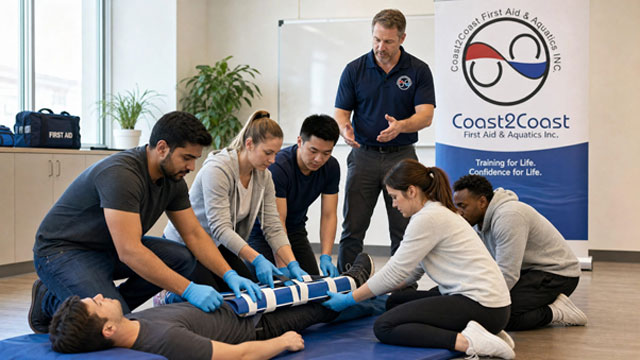
You will usually be in a small group with a certified instructor. The mood is practical, not stiff. After a quick welcome, you get your hands on the equipment early. You will kneel beside a manikin and practice compressions until the rhythm feels natural, aiming for the centre of the chest, about 100 to 120 pushes a minute, at least five centimetres deep, letting the chest rise fully between each one.
You will practice using an AED, which talks you through each step out loud. You will roll a partner into the recovery position, wrap a pressure bandage, and work through short scenarios where the instructor plays the role of a patient. Questions are welcome. Nobody expects you to be perfect, and the repetition is the point.
By the end, you sit a brief assessment. Pass it, and your certificate is typically valid for three years before you need a refresher.
If you want to compare schedules and formats before you commit, browsing the available Coast2Coast First Aid courses is an easy way to see what fits your week.
How Do You Choose the Right Course?
Ask yourself two questions. What is driving this, and who is asking for it?
If an employer or a school program set the requirement, confirm the exact level they expect before you book, so you only pay once. If you are training for your own peace of mind, CPR/AED Level C or Basic First Aid is a sensible, affordable place to start. You can always step up to Intermediate later.
Pay attention to the certifying body too. Courses backed by recognized organizations like the Canadian Red Cross or Heart & Stroke carry weight across the country, which matters if you move or change jobs.
Does the Fear of "Doing It Wrong" Hold People Back?
It does, and it is worth naming. Plenty of people worry they will freeze, hurt someone, or get into legal trouble. Here is the reassuring part.
Training exists precisely so you do not freeze. Muscle memory kicks in when your mind goes blank. And in Ontario, the Good Samaritan Act, 2001 offers legal protection to people who step in to help voluntarily and in good faith. You are far more likely to regret doing nothing than to regret trying.
Remember, even imperfect CPR is better than none. For someone whose heart has stopped, your hands on their chest are their best chance until help arrives.
Taking the First Step
Getting certified is not a huge mountain to climb. Pick your level, finish the online theory on your own schedule, show up for one short skills session, and walk out ready. Then set a reminder for three years down the road to renew.
The skills stay with you long after the certificate is filed away. You may never need them. But if you do, you will be grateful you took an afternoon to learn.
How Do You Keep Your Skills Sharp After the Course?
Here is something people rarely think about when they book. A certificate is a snapshot of what you could do on one afternoon. Skills fade if you never touch them again, so a little upkeep goes a long way.
The simplest habit is to picture the steps now and then. When you walk through a mall or an office, notice where the AED cabinets are mounted. When you watch a news story about a rescue, quietly run the sequence in your head: check, call, push. These tiny mental rehearsals keep the knowledge from gathering dust.
It also helps to talk about it. Show a family member how to call for help and put the phone on speaker. Teach an older child what choking looks like and what to do. Sharing what you learned reinforces it for you and spreads the skill through your household at the same time.
When your three years are nearly up, book the refresher before the certificate lapses. Recertification is shorter than the first course, and it keeps you current with any updates to the guidelines. A ready first aider is not someone who trained once and forgot. It is someone who keeps the skill warm.
If you are looking for first aid training near Bloor Street West, the Palmerston neighbourhood, or surrounding areas, you may reach out to Coast2Coast First Aid & Aquatics in that area.
Frequently Asked Questions
Q: How long does it take to get first aid certified in Toronto?
A: With blended learning, you finish the theory online at your own pace and then attend one short in-person skills session, often just a few hours. The exact time depends on the course level you choose.
Q: How long is a first aid certificate valid?
A: Most first aid and CPR certificates are valid for three years. After that, you take a refresher or recertification course to stay current and keep your skills sharp.
Q: What is the difference between Basic and Intermediate First Aid?
A: Basic First Aid covers the essentials and usually includes CPR, while Intermediate First Aid goes deeper into injuries and medical emergencies. Intermediate is the level many Ontario employers ask for.
Q: Do I need first aid training for my job in Ontario?
A: Many workplaces do. Under WSIB Regulation 1101, smaller shifts need one worker with Basic First Aid and larger shifts of six or more need one with Intermediate First Aid.
Q: Can I learn CPR if I have no medical background?
A: Absolutely. These courses are built for everyday people. Instructors teach each skill step by step and give you plenty of hands-on practice before you are assessed.