Daijiworld Media Network - Washington
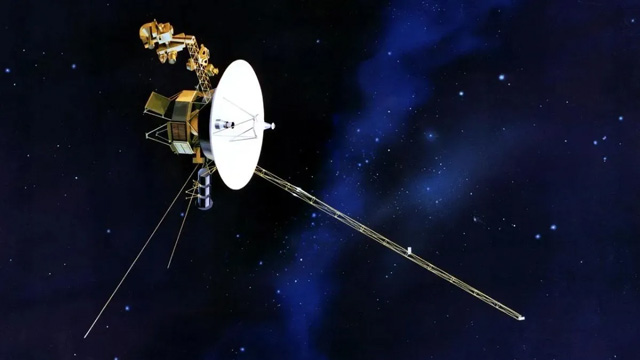
Washington, Nov 15: NASA's Voyager 1 spacecraft is set to achieve a historic milestone by becoming the first human-made object to travel one light-day away from Earth, nearly five decades after its launch.
Launched in 1977, Voyager 1 has travelled farther from Earth than any other human-made object. According to NASA, the spacecraft is expected to cross the one-light-day mark on Wednesday, November 18, at 5.16 am EST (3.46 pm IST).
A light-day is the distance travelled by light in 24 hours, equivalent to approximately 16 billion miles or 26 billion kilometres. Light travels at nearly 186,000 miles per second.
NASA estimates that Voyager 1 will have taken 49 years, two months and 11 days to cover this distance from Earth. The milestone is significant as it highlights the extraordinary distances the spacecraft has travelled through space.
Voyager 1 continues its journey through interstellar space at nearly 38,000 miles per hour, or around 61,000 kilometres per hour.
To put the distance into perspective, sunlight takes approximately eight minutes and 20 seconds to reach Earth from the Sun, while light takes around four hours and 10 minutes to travel from Earth to Neptune.
Voyager 1's twin spacecraft, Voyager 2, was also launched in 1977 but followed a different trajectory, flying past Uranus and Neptune. NASA expects Voyager 2 to reach the one-light-day milestone in November 2035.
Voyager 1 crossed the boundary of the heliosphere and entered interstellar space in 2012. It has continued transmitting scientific data from beyond the Sun's protective bubble.
NASA said Voyager 1 is heading towards a star known as AC +79 3888, also called Gliese 445, located more than 17 light-years from Earth in the constellation Ursa Minor. The spacecraft is expected to pass within approximately 1.7 light-years of the star in around 40,000 years.
The upcoming achievement highlights the remarkable longevity of the Voyager mission, which has continued exploring the vastness of space for nearly 50 years.