Daijiworld Media Network - Itanagar
Itanagar, Nov 21: Union Home Minister Amit Shah on Saturday said a new era of development has dawned across the Northeastern region, including Arunachal Pradesh, under the leadership of Prime Minister Narendra Modi, asserting that the period since 2014 would be remembered as the golden era of development in the region.
Addressing a gathering at the Police Training Academy in Banderdewa, near Itanagar, after presenting the prestigious President's Police Colour to the Arunachal Pradesh Police, Shah said it was amusing that opposition leaders often questioned the government in Parliament about its contribution to the development of the Northeast.
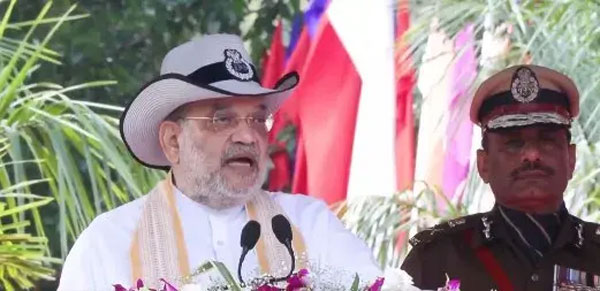
He said that whenever the history of India's development is written, the period after 2014 will be recorded as the golden era for the Northeastern region.
Shah said the Modi government had worked to reduce not only the geographical distance between the Northeast and New Delhi but also the emotional distance by expanding airport and railway connectivity across the region.
He emphasised that developing the Northeast, which is geographically larger than Uttar Pradesh and shares international borders with several countries, was the responsibility of the entire nation. He said this was the firm belief of the Union government.
Comparing the development expenditure of successive governments, Shah said the Congress-led UPA government spent Rs 33,530 crore on the Northeastern region between 2004 and 2014, while the Narendra Modi-led NDA government undertook development works worth Rs 1,49,646 crore between 2014 and 2026, marking an increase of more than four times.
He said an 18-fold increase in the Devolution Fund and a 1.5-fold increase in Grant-in-Aid reflected the government's commitment to making Northeast development a reality rather than merely a slogan. He added that substantial development work had been undertaken through budgetary allocations.
Highlighting Arunachal Pradesh's strategic importance, Shah said the state's security, peace, prosperity and development were crucial for the entire country.
Describing the President's Police Colour as recognition of courage, discipline and professional excellence, he said Arunachal Pradesh Police had become the 17th police force in the country to receive the prestigious honour, making it a matter of pride for the state.
Recalling the history of policing in the region, Shah said there was a time when Arunachal Pradesh did not have its own police force and the Assam Rifles was responsible for maintaining security.
He pointed out that Arunachal Pradesh shares an international border stretching 1,863 km, including 1,226 km with China, 520 km with Myanmar and 217 km with Bhutan. Given its extensive international boundaries, the state's security and peace were important not only for Arunachal Pradesh but also for the entire country.
Shah described Arunachal Pradesh as being situated at the gateway to the Golden Triangle, through which narcotics are smuggled into different parts of the country. He said the state was strategically important in the fight against drug trafficking.
On internal security, he praised the Arunachal Pradesh Police for its efforts in tackling insurgency, organised crime, drug trafficking and the growing menace of cybercrime. He expressed confidence that the force would discharge these responsibilities with greater enthusiasm and dedication following the conferment of the President's Police Colour.
Highlighting major infrastructure projects undertaken in the state, Shah said the 12-km-long Sela Tunnel, described as the world's longest bi-lane tunnel, had been constructed at an altitude of 13,000 feet at a cost of Rs 825 crore.
He recalled that Prime Minister Narendra Modi inaugurated the Bogibeel Bridge in 2018, connecting Pasighat in Arunachal Pradesh with Dibrugarh in Assam. The bridge is the country's longest rail-cum-road bridge.
He also cited the declaration of Glaw Lake as India's 101st Ramsar site, making it the first such site in Arunachal Pradesh, and the inauguration of the state's first authorised commercial coal mine at Namchik-Namphuk.
The Union Minister said the 1,500-km-long Arunachal Frontier Highway, estimated to cost Rs 44,000 crore, had been approved to connect border areas across the state from east to west.
He further said the foundation stone had been laid for the 2,880 MW Dibang Hydropower Project, estimated to cost Rs 32,000 crore. Eight packages of National Highway projects worth Rs 6,600 crore had also been launched, while plans for a 2,000-km-long Frontier Highway and another road along the McMahon Line had been approved.
Shah also highlighted the construction of the Nechiphu Tunnel along the 300-km-long Balipara-Charduar-Tawang road, which provides connectivity to West Kameng and Tawang districts.
On railway infrastructure, he said the annual railway budget for the Northeastern region had increased from Rs 2,100 crore in 2014 to Rs 11,486 crore in 2026-27.
He said the Donyi Polo Airport had been commissioned at a cost of Rs 650 crore, keeping security considerations in mind and with the objective of promoting tourism, trade and industry. A new greenfield airport had also been constructed at Hollongi, while the Tezu airport had been developed and made operational.
Shah expressed confidence that several power projects would enable Arunachal Pradesh to become a revenue-surplus state in a short period.
Highlighting the benefits of welfare schemes, he said nearly 23,000 farmers in the state were benefiting from the PM-KISAN scheme. Tap water connections had been provided to 2.30 lakh households, while 1.90 lakh Ayushman cards were enabling families to access medical treatment worth up to Rs 5 lakh.
On criminal justice reforms, Shah said the Union government under Modi had introduced new criminal laws by repealing the old legislation enacted during British rule. He stressed that the new laws had been passed by India's elected Parliament and provided extensive legal support for the use of technology.
He said the new criminal laws placed citizens at the centre, with their safety and security as the primary considerations. Shah added that the government had set a target of ensuring that every FIR registered after 2027 would be adjudicated within three years, including at the Supreme Court level, so that people would not face prolonged delays in securing justice.
Reiterating the Centre's commitment to eliminating narcotics, Shah said the Union Home Ministry had set a target of making the country drug-free and Arunachal Pradesh, located at the gateway to the Golden Triangle, would also be made drug-free.
He called upon the state to act as the sentinel of India and ensure that not even a single gram of drugs entered the country through its territory.
Shah said the responsibility rested with the Arunachal Pradesh Police and expressed confidence that, together, the government and the police force would make the state drug-free and prevent narcotics originating from the state from reaching any part of the country.