Daijiworld Media Network – Bengaluru
Bengaluru, Nov 27: Passengers travelling on the Bengaluru-Mumbai Vande Bharat sleeper train will now be served a compact, flight-style menu, with the Indian Railway Catering and Tourism Corporation (IRCTC) reducing the number of dishes in an effort to improve food quality, hygiene and consistency.
The initiative involves partnerships with specialised cloud kitchens and is part of a pilot project being implemented on three Vande Bharat sleeper routes.
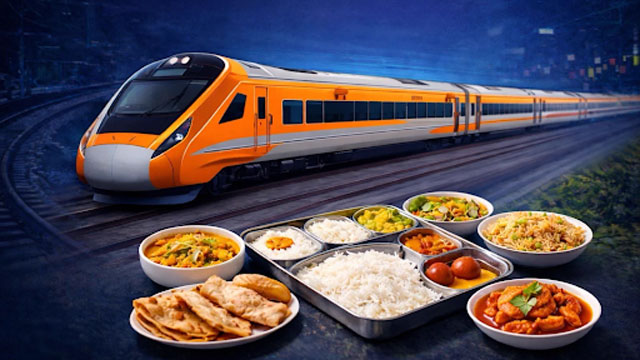
Introduced on November 1, the new arrangement replaces elaborate meal options with a limited selection of dishes. Besides Bengaluru-Mumbai, the trial is under way on the Howrah-Kamakhya and New Delhi-Varanasi Vande Bharat sleeper routes, following frequent passenger complaints about food quality on long-distance trains.
According to Hindustan Times, the initiative follows a Railway Ministry directive to address recurring complaints about catering services. A ministry official confirmed that the proof of concept was under way on all three Vande Bharat sleeper routes.
Fewer dishes, focused menu
On the Bengaluru-Mumbai service, breakfast options include idli and vada with chutney and sambhar, poha (avalakki) or upma (uppittu). Lunch and dinner will comprise chapati, rice, dal and one main dish, with a choice between chicken and a vegetarian preparation.
Several items previously served have been removed from the menu. These include soup, egg omelettes, omelette sandwiches, vegetable sandwiches, buttermilk and chocolates from breakfast. Dry vegetables, curd, salad, pickle and sweets have also been dropped from lunch and dinner.
The overall weight of an individual meal has been reduced from 700-750 grams to 450-500 grams. However, IRCTC officials have clarified that the portion size of individual food items remains unchanged.
Unlike the conventional railway catering system, meals under the new arrangement are being prepared by major cloud kitchens and hospitality groups. An IRCTC official said the corporation had partnered with the Mayfair Group for the Kamakhya route, TajSATS for the Howrah service and Sarovar Portico Group for the other two trains.
“We have also appointed cloud kitchens that supply food to airlines and hotels, where consistent food of a desired quality is produced, packaged and served,” an official said.
The shorter menu is expected to simplify quality monitoring and enable catering agencies to concentrate on fewer dishes rather than managing an extensive selection.
Complaints decline by 10%
IRCTC West Zone Group general manager Gaurav Jha said passenger complaints had declined by 10% since cloud kitchens began supplying meals under the new arrangements. “Passenger satisfaction remains IRCTC's foremost priority,” he said.
The initiative follows several incidents involving poor food quality on long-distance trains. In March, worms were reportedly found in curd served on the Patna-Tatanagar Vande Bharat. Cockroaches were found in dal on the Shirdi-Mumbai Vande Bharat in August 2024 and in a meal served aboard the Rani Kamlapati-Jabalpur Vande Bharat in February 2024.
Earlier, in October 2017, 26 passengers on the Mumbai-Goa Tejas Express fell ill after consuming meals on board in a suspected food poisoning incident.
Railway officials have also cited operational challenges in preparing elaborate meals within the limited kitchen space, manpower and time available in pantry cars.
Wider rollout under consideration
IRCTC is evaluating passenger feedback before deciding on wider implementation. Officials said catering contractors generally handle premium services such as Vande Bharat, Rajdhani and Shatabdi, alongside other express and superfast trains.
If the pilot proves successful, the compact menu system could be extended to more long-distance and premium services, with the objective of ensuring better food quality, hygiene and consistency across the railway network.