Daijiworld Media Network - Mumbai
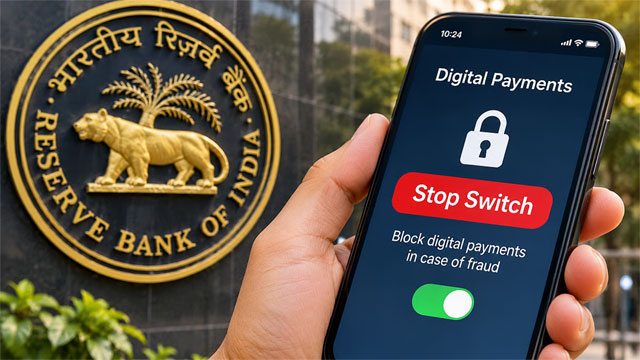
Mumbai, Nov 27: In a major push to shield bank customers from digital financial fraud, the Reserve Bank of India (RBI) has unveiled draft norms introducing an emergency 'Stop Switch' to halt outgoing payments, user-defined transaction caps and an optional 'Trusted Person Mechanism' to approve high-value transfers.
Proposed as draft amendments to the central bank's directions on responsible business conduct, the measures seek to place greater control in the hands of account holders while tightening accountability for banks in tackling electronic banking fraud.
The proposals are currently open for public and stakeholder feedback until December 14, 2026. Once finalised, the customer-facing safeguards are slated to come into force from July 1, 2027, though banks may choose to roll them out earlier. The draft norms apply across commercial banks, small finance banks, payments banks, regional rural banks, local area banks and cooperative banks.
How the 'Stop Switch' works
Designed as an immediate line of defence when an account holder suspects compromised credentials or unauthorised access, the Stop Switch will allow users to block all customer-initiated outgoing debits in a single step, eliminating the need to contact the bank to freeze individual channels separately.
Once triggered, the feature will halt all outgoing transfers, block the creation of new payment mandates or standing instructions, and prevent UPI registration on new third-party apps. However, it will not result in a complete account freeze. Incoming funds, pre-existing recurring mandates and standing instructions, as well as bank-initiated debits such as loan instalments and service charges, will continue uninterrupted. To lift the restriction, customers will need to complete a prescribed authentication process, which may include a cooling-off period or additional checks set by the bank.
User-controlled transaction limits
Moving away from a one-size-fits-all approach, the RBI has proposed letting customers tailor their own digital payment limits rather than relying solely on bank-set ceilings. Account holders will be able to fix maximum caps for single transactions, daily limits for specific beneficiaries, channel-wise daily ceilings, and an overall daily cap across all digital channels combined. Users can also schedule specific time windows during which chosen payment channels remain inactive.
For example, a customer can cap daily transfers to a specific beneficiary at Rs 20,000 even if the bank permits a higher amount, or restrict a particular payment channel to Rs 10,000 per transaction. These custom controls will also cover debit, credit and prepaid cards, enabling users to toggle domestic and international usage and set limits for ATM, point-of-sale, online and contactless transactions. Furthermore, banks will be required to keep digital payment channels switched off by default for newly onboarded customers, activating them only after explicit consent and authentication.
Trusted Person Mechanism for high-value transfers
Under the voluntary Trusted Person Mechanism (TPM), customers can nominate any individual aged 18 or above—either digitally or at a branch—to act as a secondary approver for high-value transfers exceeding a threshold set by the account holder. Banks will verify the nominee's identity using an officially valid document, and the facility will be activated only after explicit consent from both parties and a 24-hour cooling-off period.
When a transfer crosses the set limit, the nominee will receive details of the amount and beneficiary and will have one hour to approve it. If the request is rejected or goes unanswered within the hour, the transaction will be automatically declined.
To protect privacy, the nominated person will have no access to the customer's account, balance, fixed deposits, investments or insurance details, nor will they be able to initiate transactions or be held legally liable for approving or rejecting a transfer. The TPM will not cover UPI transfers, merchant payments or recurring payments via standing instructions, e-mandates and NACH mandates.
Wider definition of bank negligence
In a separate move proposed to take effect earlier, from January 1, 2027, the RBI plans to broaden the scope of bank negligence in electronic banking fraud cases. Under the revised framework, banks will be held accountable for failing to enforce prescribed authentication norms, send mandatory transaction alerts, maintain round-the-clock fraud-reporting channels, or act swiftly on customer complaints. The expanded rules will also cover specific system malfunctions, security breaches, and instances of collusion involving bank staff or third-party service providers.