Media Release
Mangaluru, Nov 27: Sahyadri College of Engineering & Management, Mangaluru, inaugurated the Third International Conference on Computing, Semiconductor, Mechatronics, Intelligent Systems and Communications (COSMIC-2026) on 27 November 2026, in association with the IEEE Bangalore Section and IEEE Mangalore Subsection.
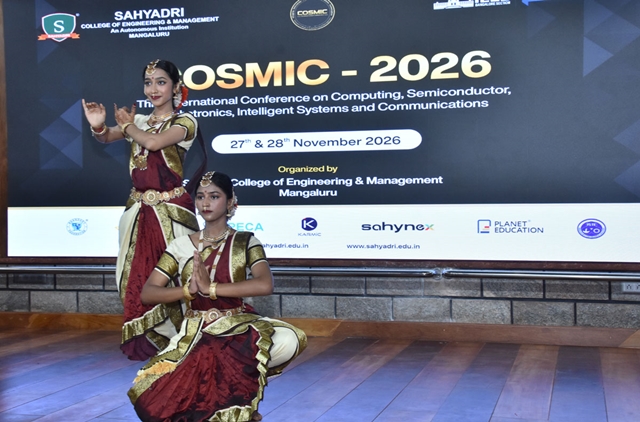
The inaugural ceremony commenced with an invocation prayer led by Shriraksha and her team, followed by the lighting of the lamp by the dignitaries. The conference was formally declared open through a traditional Tulunadu cultural welcome featuring the unfolding of the Kombu (coconut palm frond), symbolising auspicious beginnings and the spirit of new ideas.
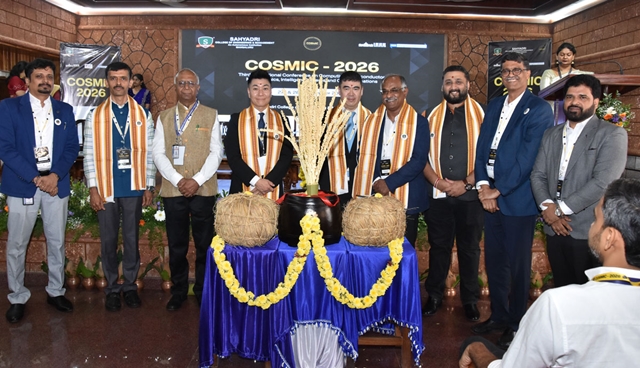
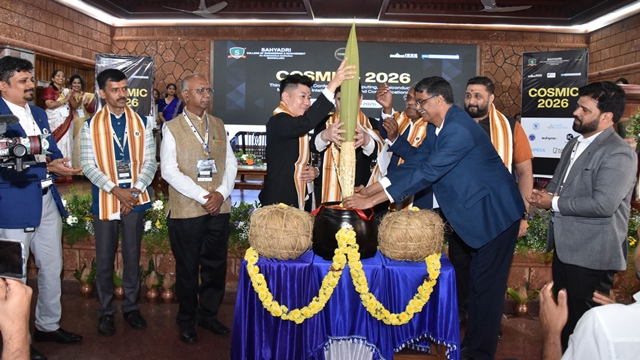
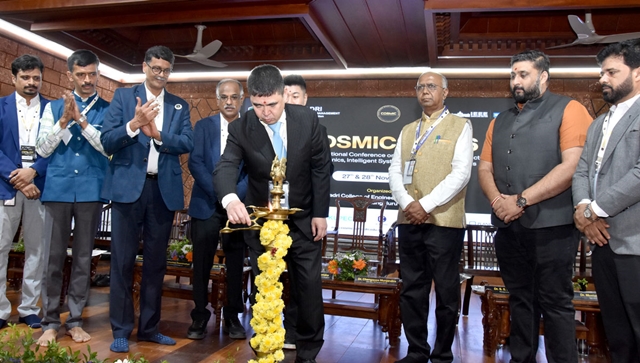
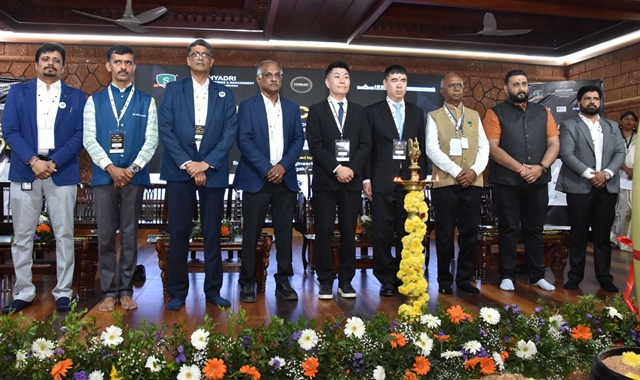
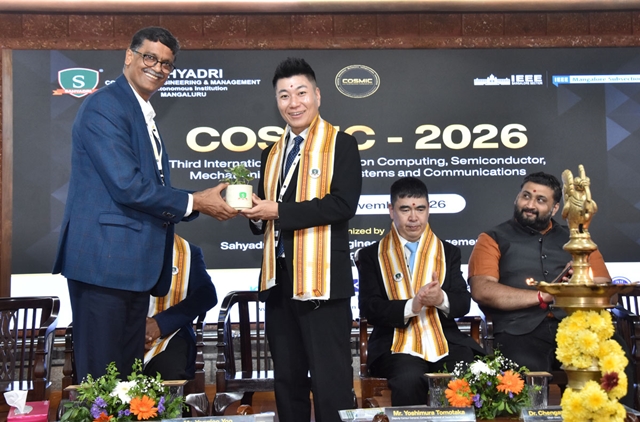
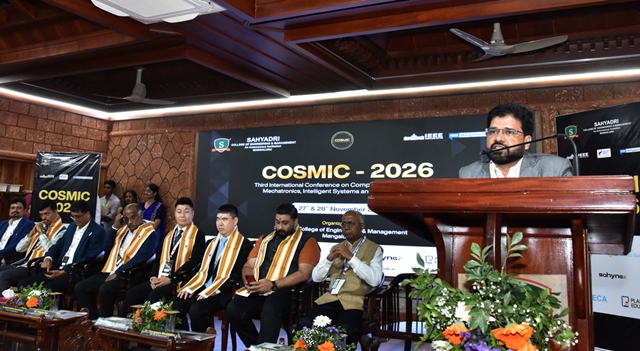
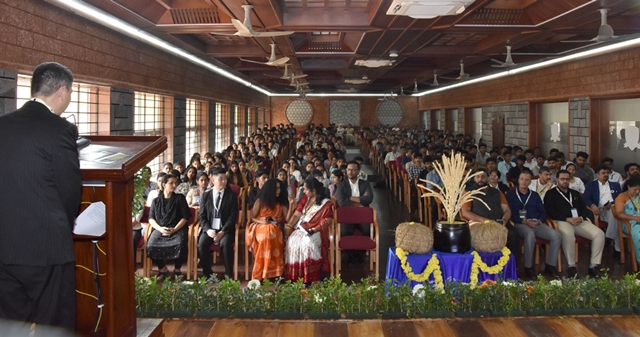
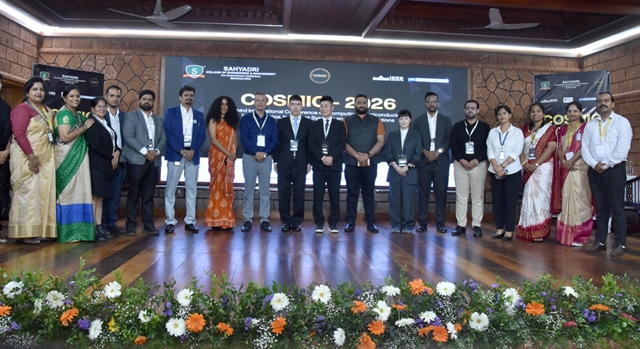
The ceremony was graced by Yoshimura Tomotaka, deputy consul general, Consulate-General of Japan in Bengaluru, as chief guest; Yongjoo Yoo, founder and CEO, Duru Corporation Pvt Ltd, South Korea; and Dr Chengappa Munjandira, senior technologist at Hewlett Packard, academic senate member, VTU, and chair-elect, IEEE Bangalore Section, as guests of honour. Dr Nedunchezhian Swaminathan, professor, University of Cambridge, UK, delivered the keynote address. Other distinguished attendees included Dr Venugopala P S, chair, IEEE Mangalore Subsection; Rahul Xavier, COO, and Zaehee Kim, strategy team lead, Duru Corporation Pvt Ltd; Yathish L Nagavalli, founder and CEO, Praxiti Technologies Pvt Ltd; and Dr Pavan Kumar C, assistant professor, IIIT Dharwad.
Delivering the welcome address, Dr S S Injaganeri, principal and general chair of COSMIC-2026, highlighted Sahyadri's innovation ecosystem, including ACIC, Idea Labs and Launchpads. Reiterating the institution's motto, "Walk in with ideas, walk out with a product," he emphasised the importance of fostering innovation, entrepreneurship, and global knowledge exchange.
Presenting the conference overview, Dr Mustafa Basthikodi, organizing chair of COSMIC-2026 and professor & head, Department of CSE, highlighted the conference's growth since its inception in 2024. He outlined the rigorous peer-review process, noting that 64 papers were selected from 1,760 submissions, reflecting an acceptance ratio of 6.55%.
Addressing the gathering, chief guest Yoshimura Tomotaka emphasised the importance of India–Japan collaboration in human resources and advanced manufacturing. Introducing the Japanese philosophy of Kaizen, meaning continuous improvement, he encouraged students to embrace lifelong learning and explore global opportunities. He also digitally released the COSMIC-2026 Book of Abstracts, compiled by Harisha.
Guest of Honour Yongjoo Yoo spoke about the changing employment landscape in the era of Artificial Intelligence and encouraged students to remain adaptable, embrace technology and learn from failures. Sharing the message, "Keep trying and be ready to fail," he highlighted perseverance as an essential quality for innovation.
Dr Chengappa Munjandira emphasised the contributions of the IEEE Mangalore Subsection and encouraged researchers to translate their research into practical applications. Dr. Venugopala P. S. highlighted the importance of research quality and interdisciplinary collaboration while drawing attention to India's AI Vision, AI Kosh initiative and the development of local-language Large Language Models.
In his presidential address, Krishna Hegde, trustee and administrator, spoke about the vision of Viksit Bharat, highlighting India's infrastructure growth and the need to develop skilled human resources and socially responsible leaders.
The programme concluded with the presentation of mementos to the dignitaries by Dr S S Injaganeri and Krishna Hegde, followed by the vote of thanks proposed by Dr Anush Bekal, organizing co-chair of COSMIC-2026 and professor & head, Department of ECE. The ceremony concluded with the National Anthem.
The inaugural proceedings were coordinated by Monisha Shetty, who served as the master of ceremonies before handing over the proceedings to Prof Sheryl Colaco for the subsequent technical sessions.
Keynote Address on AI/ML for Future Propulsion and Power System Design
Professor N Swaminathan, University of Cambridge, United Kingdom, delivered a keynote address on “Use of AI/ML for Future Propulsion and Power System Design” at COSMIC-2026. He highlighted the applications of Artificial Intelligence and Machine Learning in sustainable power systems, carbon emission reduction, engine simulations and propulsion design, introducing the concept of Digital Twins.
Emphasising the importance of strong fundamentals and domain knowledge, he encouraged students to use AI responsibly, develop critical thinking and verify AI-generated information rather than accepting it blindly. The session was introduced and concluded with the vote of thanks by Sharel.
Japanese and Korean Delegation Visit and Cultural Exchange Programme:
On the Third International Conference, COSMIC-2026, Sahyadri College of Engineering & Management hosted a delegation from Japan and South Korea to strengthen international partnerships and explore opportunities for student engagement and placements. The longstanding association with the Japanese company, dating back to 2017, has facilitated regular campus recruitment activities. The programme featured welcome addresses and cultural performances, including traditional dances and a Japanese song presented by students. The Korean representative addressed the gathering, encouraging cross-cultural interaction. The visit fostered cultural exchange, strengthened institutional ties and provided students with valuable global exposure, celebrating friendship and collaboration between India, Japan and South Korea.
Technical Paper Presentation – Session 1: Intelligent Systems
The first technical paper presentation session on Intelligent Systems at COSMIC-2026 was chaired by Dr Dinesh Naik, assistant professor (Grade I), NITK Surathkal, and Dr Shamanth Rai, dean – academics and professor, Department of ISE, SCEM. The session featured five research papers covering advancements in Artificial Intelligence, Machine Learning and Deep Learning, with applications in retinal disease identification, EEG-based emotion recognition, rice grain classification, electrical grid stability and deepfake detection. Each presentation was followed by an interactive question-and-answer session, providing researchers an opportunity to receive constructive feedback and exchange technical insights.
Technical Paper Presentation – Session 2: Intelligent Systems
The second technical paper presentation session at COSMIC-2026 was chaired by Dr Ragavendra S, associate professor, MIT, MAHE, Manipal, and Dr Nagesh H R, professor, Department of CSE, Canara Engineering College. The session featured five research papers showcasing advancements in Artificial Intelligence, Machine Learning and Deep Learning, with applications in online examination misconduct detection, retinal vein occlusion analysis, multi-crop price prediction, turmeric leaf disease classification and maritime traffic pattern modelling. The presentations provided an engaging platform for researchers to share their findings, receive constructive feedback and exchange insights into emerging technological applications.
Technical Paper Presentation – Session 3: Computing
The third technical paper presentation session at COSMIC-2026 was chaired by Dr Venugopala P S, NMAMIT, Nitte, and chair, IEEE Mangalore Subsection, along with Dr Pushparaj Shetty, NITK Surathkal, and senior member, IEEE. The session featured four research papers highlighting advancements in Quantum Signal Processing, Hardware Adaptive Filtering, Cloud AutoML and Cloud Computing Infrastructure. The presentations explored applications in signal denoising, hardware-based adaptive filtering, breast cancer classification and cloud-based CNN training, providing a platform for researchers to present their findings and exchange technical insights.
Technical Paper Presentation – Session 4: Computing
The fourth technical paper presentation session at COSMIC-2026 was chaired by Dr Yashwanth N, associate professor, School of Electrical Engineering MIT, Manipal, and Dr Ashwini P, head, Department of ISE, Nitte, and former IEEE joint secretary. Coordinated by Vasudha Rao P the session featured five research papers focusing on underwater communication, secure online voting using Zero-Knowledge Proofs, Explainable AI-based academic risk prediction, post-quantum cryptography and privacy-preserving cloud computing. The presentations provided an engaging platform for researchers to showcase innovative solutions, receive constructive feedback and exchange technical insights on emerging challenges in communication, cybersecurity, and data privacy.
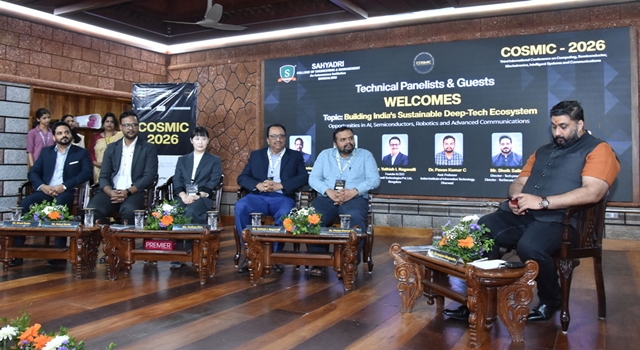
Panel Discussion: Bridging Education and Industry in DeepTech
The panel discussion on “Bridging Education and Industry in DeepTech” was moderated by Dr Chengappa Munjandira, senior technologist, Hewlett Packard; academic senate member, VTU; and Chair-Elect, IEEE Bangalore Section. The panel comprised Rahul Xavier, COO, Duru Corporation Pvt Ltd, South Korea; Zaehee Kim, strategy team lead, Duru Corporation Pvt Ltd, South Korea; Yathish L Nagavalli, founder and CEO, Praxiti Technologies Pvt Ltd, Bengaluru; Dr Pavan Kumar C, assistant professor, IIIT Dharwad; and Sheik Salim Abdul Rahaman, executive director, Techproxima,UAE.
The discussion focused on strengthening academia–industry collaboration, translating research into market-ready products, global best practices in DeepTech education, and challenges in scaling DeepTech ventures in India. The panellists highlighted the need for stronger university–industry partnerships, an entrepreneurial mindset, effective stakeholder coordination, and greater willingness to experiment and innovate. Drawing insights from South Korea’s industry-linked education model, they emphasised applied research, global quality standards, and the importance of combining technical expertise with well-rounded professional skills. Key challenges identified included bridging the research-to-product gap, identifying relevant industry problem statements, securing early customers, and accessing patient capital for DeepTech startups, particularly in emerging innovation ecosystems.
The session concluded with an interactive rapid-fire round, featuring few questions that encouraged candid perspectives on innovation, entrepreneurship, and the future of DeepTech.