Daijiworld Media Network - Mangaluru
Mangaluru, Dec 27: Even before the chill of January reaches the shoreline, preparations have been stepped up along the coast to protect sea turtles, with the forest department implementing advance measures ahead of the nesting season.
Anticipating the arrival of Olive Ridley turtles for egg-laying, the department has launched a proactive conservation programme to safeguard eggs and hatchlings, while also creating awareness about the importance of wildlife protection among the public.
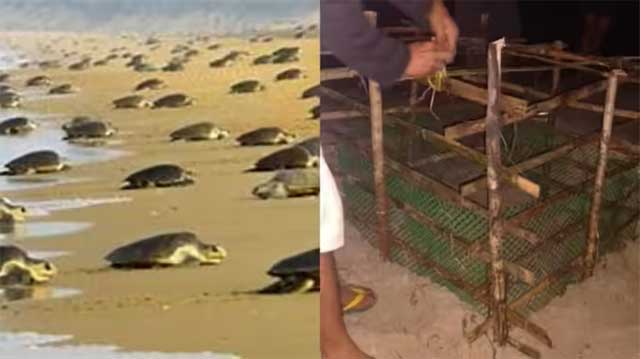
Special protective hatcheries have been set up at key coastal locations including Sasihithlu, Iddya and Bengre. Information about turtles coming ashore at night to lay eggs is gathered with the help of fishermen and forest personnel. The eggs are then carefully relocated to secure hatcheries, where round-the-clock protection is provided until the hatchlings emerge. After hatching, the young turtles are safely released into the sea. The entire process is monitored through CCTV surveillance, officials said.
During the 2024–25 season, a total of 24 hatcheries were prepared — eight at Sasihithlu, one at Bengre and 13 at Iddya. As many as 2,490 turtle eggs were collected from these sites. Of them, 1,842 hatchlings successfully emerged, recording a survival rate of 73.97 per cent. This marks a significant improvement compared to the previous season’s survival rate of 50.3 per cent, the department noted.
Forest officials explained that sea turtles are not rare creatures but are vital indicators of ocean health. By feeding on jellyfish species, Olive Ridley turtles help maintain ecological balance in marine ecosystems. The increasing nesting activity of Olive Ridley turtles along the stretch from Karwar to the southern coast is being viewed as a positive sign for the marine environment.
Officials emphasised that the hatcheries are not merely meant to protect turtle hatchlings, but also serve as a reminder to future generations about their responsibility towards conserving marine life.
Key facts on turtle conservation
-
Hatcheries: 24 (Sasihithlu – 8, Bengre – 1, Iddya – 13)
-
Eggs collected: 2,490
-
Hatchlings released: 1,842
-
Survival rate: 73.97 per cent
-
Law: Destruction of turtle eggs is a grave offence, on par with tiger poaching
Mangaluru forest range officer Manoj warned that harming turtles or destroying their eggs is a serious offence under Schedule I of the Wildlife Protection Act, carrying penalties equivalent to those for killing a tiger.
He also pointed out that during the monsoon, when fishing activity is reduced, turtles are often found washed ashore dead, mainly due to rough seas and marine pollution. Plastic waste, discarded fishing nets and the discharge of hot water from industrial units into the sea pose serious threats to turtle survival. Sightings of live turtles in the sea have reduced over the years, while incidents of dead turtles washing ashore have increased, he added.