Daijiworld Media Network – New York
New York, Feb 21: Awake brain surgery, medically known as Awake craniotomy, is among the most remarkable advances in modern neurosurgery. The technique is designed not only to remove brain lesions or tumours, but also to preserve the essential functions that define a person’s identity—such as speech, movement and sensation.
This specialised procedure is usually recommended for patients with a space-occupying lesion located near the brain’s “eloquent areas”—regions responsible for speaking, understanding language and voluntary movement. When tumours develop close to these critical zones, surgeons face the dual challenge of safely removing the abnormal growth while ensuring the patient’s quality of life remains intact.
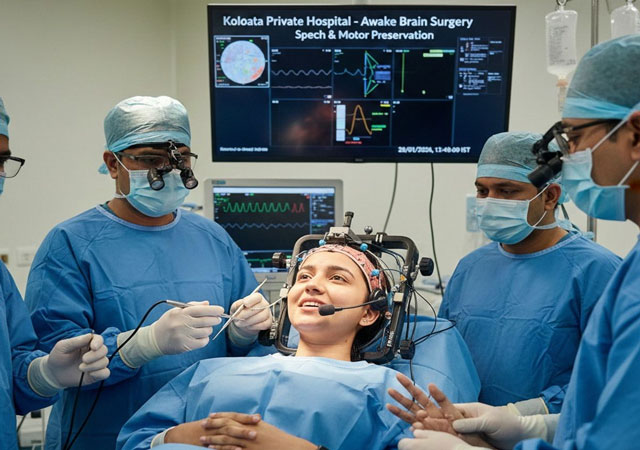
Unlike conventional procedures performed entirely under general anaesthesia, awake brain surgery allows neurosurgeons to monitor critical neurological functions in real time. This significantly reduces the risk of long-term deficits in speech or motor abilities.
What the procedure involves
Despite common fears, the surgery is not painful. The brain itself does not have pain receptors. During the operation, the scalp and surrounding tissues are numbed with local anaesthesia, and the patient is given sedation to remain relaxed and comfortable.
The patient is awakened only during specific stages—primarily during brain mapping, when surgeons identify functional areas of the brain. At these moments, the patient may be asked to speak, count, move their arms or legs, answer questions, or even sing.
These simple tasks provide continuous live feedback. Even subtle changes in speech, voice or movement alert the surgical team that they are approaching critical neural pathways. This precision enables safe removal of the lesion while preserving vital brain functions.
Teamwork makes it possible
Awake brain surgery requires seamless coordination among a multidisciplinary team that includes neurosurgeons, anaesthetists, neurologists, speech and language therapists, psychologists and specialised nursing staff.
Before the operation, patients undergo extensive counselling and psychological assessment to ensure they are mentally prepared and confident about the procedure.
Clearing misconceptions
There are several misconceptions surrounding awake brain surgery. One common belief is that patients experience pain or fear during the operation. In reality, the combination of local anaesthesia and sedation keeps them comfortable.
Another misconception is that being awake increases surgical risk. On the contrary, real-time interaction with the patient reduces the likelihood of postoperative speech or movement impairments. It is also important to note that awake brain surgery is not performed in all brain operations. It is selectively used only when lesions are located near critical functional areas.
A life-changing outcome
In a recent case, a young woman with a lesion close to her speech and motor centres underwent awake brain surgery. During the procedure, she was asked to speak and sing, allowing surgeons to continuously monitor her speech pathways as they carefully removed the lesion. The operation was successful, and she retained her speech and movement abilities.
Redefining surgical success
Awake brain surgery has transformed the definition of success in neurosurgery. It goes beyond survival, prioritising independence, dignity and quality of life. With proper patient selection and an experienced multidisciplinary team, this well-established technique offers patients not just treatment—but the ability to return to their lives with their identity preserved.