Daijiworld Media Network - Jerusalem
Jerusalem, Apr 5: The Holy Week, a sacred period marking the arrest, crucifixion and resurrection of Jesus, is unfolding under an atmosphere of silence and restriction in the Old City of Jerusalem, where the Christian Quarter remains largely deserted.
Shops are shut and streets are empty, with local businesses severely affected by restrictions imposed during the ongoing conflict involving Israel and Iran. A Palestinian Christian shopkeeper, identified as Boulos, said he continues to open his store partially despite minimal customers, struggling to sustain himself.
“Before the war, business was already bad, but at least enough to survive. Now there is no business at all,” he said, pointing to the collapse of tourism, a key lifeline for the local Christian community.
Authorities have restricted operations in the Old City due to the absence of nearby shelters, unlike in West Jerusalem where businesses remain open. The impact has been most visible in the Christian Quarter, heavily dependent on pilgrims.
Educational and religious life has also been disrupted. Brother Daoud Kassabry, principal of a local school, said in-person classes have been suspended for over a month, while traditional events such as Palm Sunday processions have been cancelled.
In an unprecedented move, Israeli authorities barred senior church officials, including Pierbattista Pizzaballa, from entering the Church of the Holy Sepulchre for Palm Sunday Mass, marking what church authorities described as a rare historical occurrence.
Following international criticism, including from leaders in the United States and Europe, Israeli Prime Minister Benjamin Netanyahu later allowed limited religious ceremonies during Holy Week, though access for the general public remains restricted.
Local Christian leaders say such measures, along with ongoing tensions, have deepened feelings of marginalisation. Bishop Emeritus Munib Younan highlighted incidents of harassment, while others pointed to increasing difficulties in practising faith freely.
Restrictions have also extended to Muslim worshippers, who have reportedly faced curbs at the Al-Aqsa Mosque compound in recent weeks.
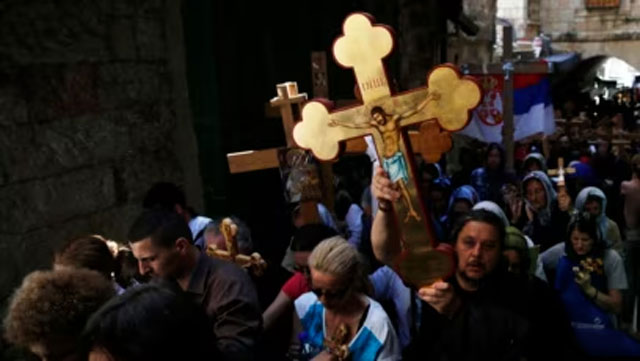
With public religious events like the Way of the Cross procession cancelled, community leaders warn of long-term impacts on Jerusalem’s shrinking Christian population, now less than two per cent of the region.
Many young Christians are considering emigration due to limited opportunities and ongoing instability, raising concerns about the future of the community.
Despite the hardships, local clergy have urged resilience. “Steadfastness is not passive endurance but a form of spiritual resistance,” said Father Faris Abedrabbo, encouraging believers to hold on to hope during the difficult period.